Is free speech under attack more in the UK or the US?
That was a question for President Donald Trump and British Prime Minister Keir Starmer at a press conference that concluded the US President’s state visit on Thursday, 18 September.
This past week, the issue has dominated debate in the US following the killing of conservative activist Charlie Kirk and is intensifying.
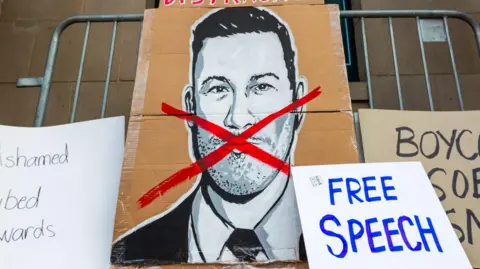
Attorney General Pam Bondi pledged to target people who use hate speech, attracting a backlash. During a podcast interview, Bondi said, “We will absolutely target you, go after you if you are targeting anyone with hate speech, and that’s across the aisle.”
Her pledge and comments by other officials have people on both sides of the political divide fearful of an attack on free speech.
Some of those comments came from figures like Vice-President JD Vance, who said people who celebrate the Kirk’s killing should be held accountable. “Call them out, and hell, call their employer. We don’t believe in political violence, but we do believe in civility.”
It’s been reported that workers, including pilots, medical professionals, teachers and a Secret Service employee, have been suspended or sacked because their social media posts about Kirk’s death were deemed ‘inappropriate’. The company, Office Depot, fired employees for refusing to print posters for a Kirk vigil.
Jimmy Kimmel Suspension
One of the most high-profile cases involves late-night host Jimmy Kimmel, who was pulled off air ‘indefinitely’ by ABC after comments he made about Kirk’s assassination. The suspension came after Federal Communications Commission Chair Brendan Carr told a right-wing podcast the F.C.C. has “remedies we can look at’’ and said it is past time that a lot of “licensed broadcasters” who carry ABC’s programming push back against the parent network.
A number of Democratic lawmakers criticised the decision, saying free speech was under attack. Senator Bernie Sanders said: “This country is rapidly moving toward an authoritarian form of society. In authoritarian countries—like Russia and Saudi Arabia—you do not have a media that is allowed to be critical of the government.”
Six House Democratic lawmakers, including Democratic leader Hakeem Jeffries, said in a joint statement: “Brendan Carr, the so-called Chairman of the Federal Communications Commission, has engaged in the corrupt abuse of power. He has disgraced the office he holds by bullying ABC, the employer of Jimmy Kimmel, and forcing the company to bend the knee to the Trump administration.”
Media Cowardice
The leaders also targeted the media, saying media companies, such as the one that suspended Mr Kimmel, have a lot to explain. “The censoring of artists and cancellation of shows is an act of cowardice”.
The Writers Guild of America said in a statement: “The right to speak our minds and to disagree with each other – to disturb, even – is at the very heart of what it means to be a free people. It is not to be denied. Not by violence, not by the abuse of governmental power, nor by acts of corporate cowardice.”
Presidential Promises
President Trump started his second term promising to promote free speech. In his inaugural address in January, he said: “After years and years of illegal and unconstitutional federal efforts to restrict free expression, I also will sign an executive order to immediately stop all government censorship and bring back free speech to America.”
But, as an article for MDI stated, Trump’s second term started with an attack on press freedom, which reached much greater proportions than anything witnessed under his first administration. “Trump has long been famous for calling journalists ‘enemies of the people, but his first-term assault on the press was mostly rhetorical. This time around, it looks like he has a systematic plan to bring the press to heel. Even worse, it might be working.”
The International Bar Association said in May that the Trump administration has executed a “wide-ranging crackdown on freedom of speech by targeting student protestors, lawyers and the press”.
How Free is the UK?
US officials have been expressing their concerns over crackdowns on free speech, but in the UK.
The administration considers it a major issue following the far-right march over the weekend, the arrests of people who posted inflammatory anti-migrant messages during the 2024 summer riots, and the arrest of a comedian turned anti-transgender activist for comments he posted online.
Transatlantic tensions have extended to UK tech regulation governing AI and social media platforms. Vice President JD Vance has accused Britain of backsliding in the age of social media, saying its tech rules affect “not just the British, but also affect American technology companies and, by extension, American citizens”.
The latest US State Department Report on Human Rights Practices says the human rights situation has worsened in the United Kingdom. It cited “significant human rights issues included credible reports of serious restrictions on freedom of expression, including enforcement of or threat of criminal or civil laws in order to limit expression; and crimes, violence, or threats of violence motivated by antisemitism”.
When answering that question at the press conference with President Trump, Prime Minister Starmer said Britain “fiercely” protects free speech, but when it was used to incite real harm to children and vulnerable people, there was a limit.
“Free speech is one of the founding values of the United Kingdom, and we protect it jealously and fiercely and always will.”
The UK is ranked 20th on the 2025 World Press Freedom Index, ahead of the US on 57th.
The debate and divisions over freedom of speech are likely to intensify in the coming days and weeks, especially in the United States. What happens next could determine whether a diverse range of opinions, vibrant debate, and a responsible media that holds power to account, struggles or thrives.