Watch the full recording: https://www.youtube.com/watch?v=7HU-Yjxk74k
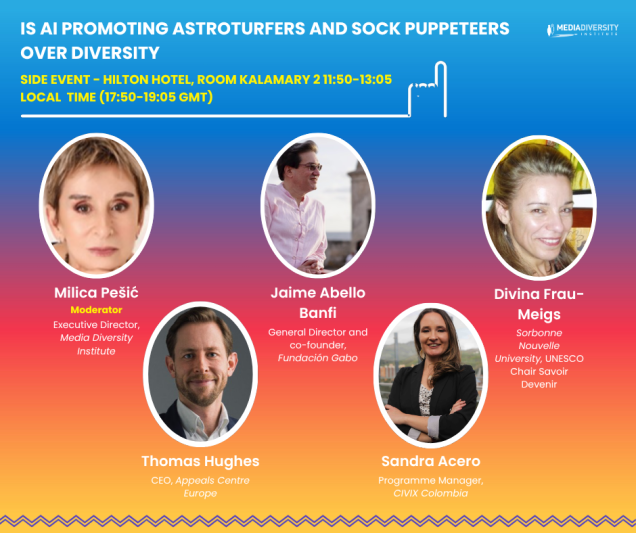
On Friday, 24 October 2025, the Media Diversity Institute hosted an English-language panel at UNESCO’s Global Media and Information Literacy (MIL) Week at the Hilton Cartagena, with a live Facebook stream. The discussion asked a blunt question: Is AI elevating astroturfers and sockpuppeteers at the expense of diversity, or can civic voices still set the agenda?
Artificial intelligence now mediates much of what we read, watch and share. Jaime Abello Banfi, Director General of Fundación Gabo, cautioned that this shift carries real civic risk: “We must recognise that times are changing and that AI is the new mediator between people and the media. This creates an environment where, if people are not prepared, we will see a retreat of critical thinking. In that sense, one role of journalists is to investigate and raise awareness in civil society.”
The panel stressed that accountability begins with data. Thomas Hughes, Executive Director of Appeals Centre Europe, argued that regulators need to “ensure the use of high-quality datasets, a broad and diverse data lake, and place human rights within the model and at the heart of any regulatory framework.”
Keeping AI grounded in real life was another through-line. Divina Frau-Meigs, Professor at Sorbonne Nouvelle University and UNESCO Chair Savoir Devenir, urged a practical literacy that starts with provenance and bias: “Teach people how to ride the wave of AI, identify where the data comes from and what training biases it has. Keep AI close to our lived experiences, bringing meaning into practice.”
The conversation also confronted bias that predates any algorithm. Sandra Acero, Programme Manager at CIVIX Colombia, noted that AI often mirrors human failures: “What AI is doing is replicating something we humans have done time and again, repeating a lack of respect for diversity.”
Together, these perspectives point to a simple test for AI in public life: does it widen who gets heard, or narrow it? The answer depends on stronger media literacy, rights-centred regulation, and newsroom practice that investigates and explains how systems shape the public sphere.
Speakers
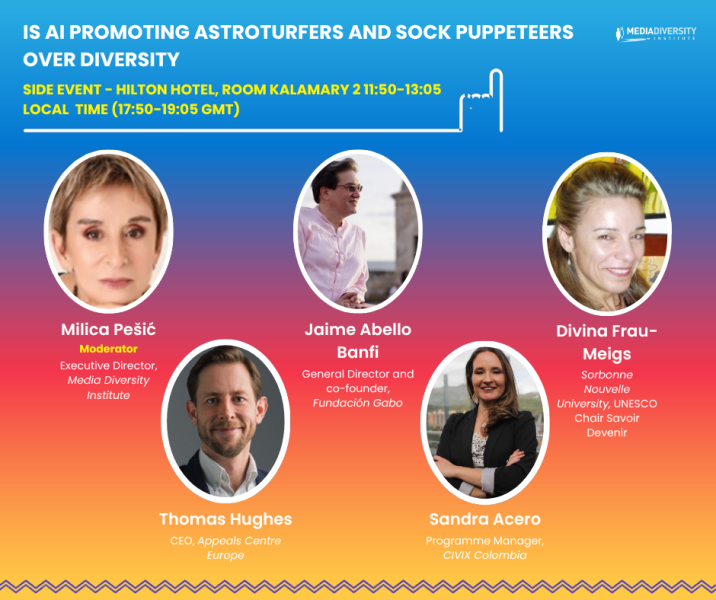
- Milica Pesic, Executive Director, Media Diversity Institute (Moderator)
- Thomas Hughes, Executive Director, Appeals Centre Europe
- Jamie Abello Banfi, Director General, Fundación Gabo
- Sandra Acero, Programme Manager, CIVIX Colombia
- Divina Frau-Meigs, Professor at Sorbonne Nouvelle University, UNESCO Chair Savoir Devenir