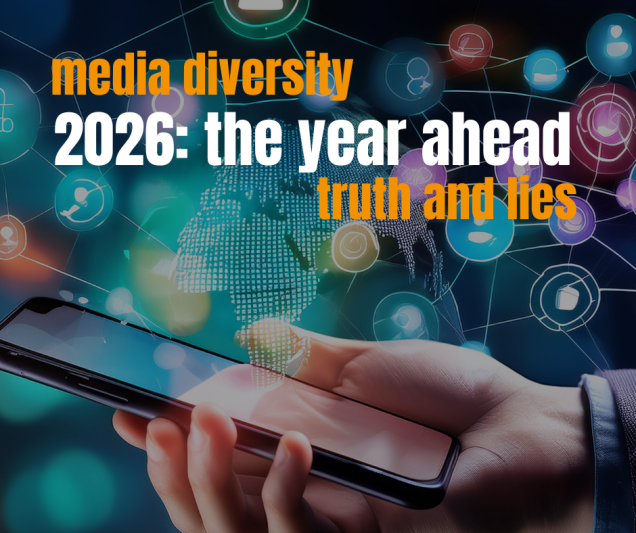
With trust in news organisations continuing to fall in some countries, misinformation still flooding social media and AI producing more convincing fake videos and content, who will “own” the truth in 2026?
And how will the fight over fact and fiction impact diversity in the media?
Tracking the “truth”
At the end of 2025, the fight to control the narrative on what is the truth kicked up a level in the United States with the President’s Office setting up a tracker and webpage to record what it calls the media’s “false and misleading stories flagged by the White House”.
The site includes an “offender of the week,” “repeat offenders” and an “Offender Hall of Shame”. There are categories for “offences” including Bias, Left-wing lunacy, Lie, Mischaracterization, Malpractice, Omission of context, Clickbait, Misrepresentation, and Circular Reporting.
A White House press release on 1 December for the launch of the tracker and website said: “Coupled with the White House Rapid Response account on X, the Trump Administration is pushing back in real time to ensure the American people get the unfiltered truth — no ideological filter, no corporate spin, only the facts so they can decide for themselves.”
The very organisations the president’s site is targeting, are continuing to push back with their own fact checking.
Outlets including PBS, Fact Check, The New York Times and CNN among others, track the president and his administration’s claims to verify whether they are the true, misleading or inaccurate.
Truth as a casualty: the year of lies
Naming 2025 the Year of the Lies, PolitiFact said “the concept of truth feels particularly bleak in 2025”.
PolitiFact Editor-in-Chief Katie Sanders told PBS: “The stakes are high for facts and the erosion of information integrity.”
“The lows of the year for political rhetoric and influential speech are not the White House’s alone. We’re contending with a really fraught online information environment, where A.I. slop is abundant, misleading, out-of-context narratives abound, and you just can’t believe what you see.”
One of the key findings of an International Centre for Journalists, City St George’s, University of London, the University of Maryland, and Arizona State University report: Disarming Disinformation: United States, released in October, was that truth has become a casualty of Trumpism.
“President Trump was the dominant source and spreader of disinformation in our content analysis, indicating his central role in disseminating false information covered by diverse ethnic and Indigenous news outlets. There is a correlation between the rise of Trumpism on one hand and the loss of trust in journalists as ‘watchdogs’/ ‘truth seekers’ on the other, resulting in a surge in disinformation and conspiracy theories, including those directed at the journalists and the communities they serve.”
The report focused on community-based news organisations which are trusted information sources within particular racial and linguistic groups, including Indigenous, Black and immigrant audiences.
Loss of trust
Opinion polls show that local media is more trusted than national news organisations across the US.
A Gallup poll released in October found that Republicans’ confidence in mass media to report news “fully, accurately and fairly” is now at 8 per cent. Just 28 per cent of Americans have a “great deal” or “fair amount” of trust in newspapers, television and radio to report the news fully, accurately and fairly. That is down from 31 per cent in 2024 and 40 per cent from five years ago.
Across the general population, the majority of US adults (70%) say they have “not very much” confidence (36%) or “none at all” (34%) in reporting. In the 1970s around 70 per cent had confidence in reporting. By 1997 it was 53 per cent and has not been a majority view since 2004.
The Pew Research Centre had similar survey findings in October, with Americans’ trust in information from national and local news organisations declining in both major political parties and across all age groups.
It found overall, 56 per cent of adults say they have a lot of or some trust in the information they get from national news organisations – down 20 points since the question was first asked in 2016. Fewer than half of Republicans and Republican-leaning independents (44%) have at least some trust in the information that comes from national news organisations.
Trust in local news is higher, with 70 per cent having at least “some trust”, a fall from 82 per cent in 2016.
Both Republicans and Democrats have the same levels of “some trust” in information from social media sites (37% in each group say this). Those under 30 trust information from national news organisations (51%) as much as from social media sites (50%).
The global outlook
The loss of trust in the media is not unique to the US. The Reuters Institute Digital News Report 2025, which covered 48 nations, found overall trust in the news has remained stable for the third year in a row at 40 per cent.
More than half (58%) of those surveyed are concerned about their ability to tell fact from fiction when it comes to news online. Those most concerned are in Africa (73%) and the United States (73%).
When it comes to who is responsible for false or misleading information, online influencers and personalities (47%) and national politicians (47%) are seen as the biggest threats worldwide.
Fighting disinformation
There are numerous projects trying to build trust and equip people with the skills to combat misinformation.
Media Diversity Institute Western Balkans (MDI WB) leads the MLADI in defence of facts for more resilient local communities project, which aims to empower young people to recognise and critically analyse mis- and disinformation and harmful narratives. The project enables youth to develop media literacy and critical thinking skills so they are better able to recognise and counter the manipulation of media content.
MDI WB is also a project partner of the recently launched project InfoFacto, a youth-centred media literacy platform helping youth assess digital content, engage with diverse perspectives, and navigate AI-driven misinformation.
“It is essential to work with all ages and groups of people to build media literacy skills, not only to recognise disinformation, but to at least try to provide the tools to navigate the increasingly complex and harmful media space,” said Anja Anđušić, MDI WB Project Manager and Researcher.
“These initiatives are growing in importance each day as new challenges keep popping up,” she added.
Impact on diversity
The fight against mis- and disinformation has far-reaching consequences.
Misinformation often targets minority groups, straining social cohesion. Other targets include health, security and climate information, making misinformation a security threat and challenge to democracy.
Who will win the battle?
With the growth of AI-generated fake news and videos which are increasing difficult to identify as false, a rise in chatbots being used as a source of news, and populist politicians increasingly bypassing traditional media in favour of friendly partisan outlets, the media faces a tough fight to dominate narratives on the “truth”.
What’s needed is a reversal in the decline of trust in the media, increased critical thinking skills to combat misinformation and navigate an AI-dominated information ecosystem, and a public that is willing to disengage from highly polarised political and media environments.
As Jaime Abello Banfi, Director General of Fundación Gabo, warned at a MDI panel at UNESCO’s Global MIL Week in Colombia in October 2025: “We must recognise that times are changing and that AI is the new mediator between people and the media. This creates an environment where, if people are not prepared, we will see a retreat of critical thinking.”