By Anthea Kasonga
For years, public debate has centred on the manosphere, its influencers, rhetoric, and impact on young men. While the harms of the manosphere are documented, a parallel concept has emerged in media and research: the “womanosphere”.
Unlike the well-analysed manosphere, the womanosphere remains less defined and far less scrutinised. Yet this online ecosystem is quietly shaping how femininity is presented, understood, and performed across digital platforms.
While it is often framed as a counterpart to the manosphere, that comparison misses the key differences in purpose, audience, and tone.
The womanosphere is not simply a reflection of the manosphere. Instead, it operates on different platforms, mechanisms, and cultural frameworks, creating a distinctly different online environment.
Not the same problem, but still a problem
The manosphere is built on misogynistic communities that frame gender equality as an attack on men, that treat women as adversaries, and that, at their edges, have been linked to radicalisation and violence.
The womanosphere, while spreading anti-feminist narratives, carries its own distinct harm—one that is harder to identify because it is often cloaked in appealing aesthetics. A gender stereotype does not need to be overtly hostile to cause damage. The issue is not that the womanosphere promotes femininity. It often promotes a narrow version of it, presented as universal.
These dynamics define the womanosphere, where leading voices urge young women to adopt narrow ideals of marriage, family, and domesticity, often casting modern feminism as antagonistic. This content defines womanhood in specific terms, presenting it as natural rather than ideological.
Comparing the two risks, overstating one threat, understating the other, and missing the womanosphere’s unique, subtle, persistent influence—especially on women who may never see the manosphere.
A different platform, a different kind of influence
Unlike male-dominated online spaces, the womanosphere operates with distinct mechanics, platforms, and strategies of influence.
It’s not based on debate or authority. Instead, influence spreads on Instagram, TikTok, and Facebook through visuals, routines, and repetition.
Ideas do not gain traction because they are argued. They gain traction because they are seen, imitated, and normalised.
In this environment, ideology is not delivered directly. It is absorbed through aesthetics.
That distinction changes how influence works. In the manosphere, ideology tends to be explicit. In the womanosphere, it is embedded in the aesthetic.
The tradwife and the algorithm
The clearest illustration of that is the tradwife trend.
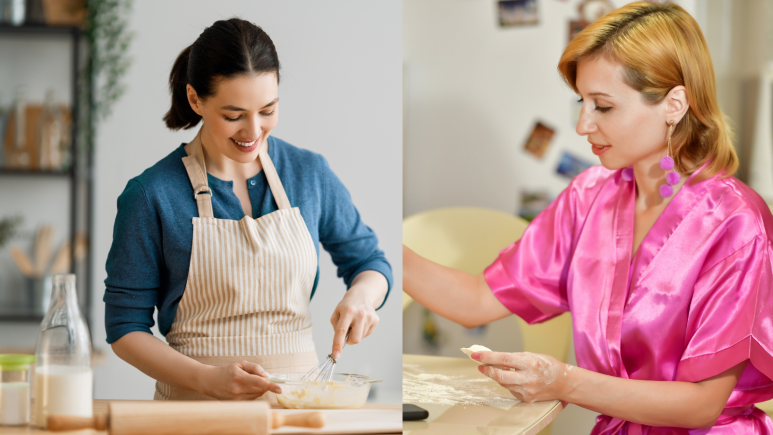
The tradwife online trend, short for traditional wife, is one of the most visible archetypes within the womanosphere. She is often depicted in soft light, in spacious kitchens, baking bread, caring for children, or describing the tranquillity she has found in “choosing” domesticity. This content is warm, aesthetically pleasing, and deliberately unhurried. It presents itself not as political commentary, but as a lifestyle ideal.
Hannah Neeleman, known online as Ballerina Farm, is perhaps its most prominent face, a mother of eight with over 20 million followers across TikTok and Instagram, whose content has made homesteading feel quietly aspirational to audiences far beyond explicitly conservative spaces.
That reach is key to understanding the womanosphere’s wider impact. Conservative women’s media realise that personal ideas are more lasting than arguments.
Publications like Evie Magazine have built large audiences by making a vision of womanhood seem natural rather than political. Its politics succeed by pretending to have none.
A political project in soft focus
This shift is not entirely organic.
Precision Strategies’ research suggests conservative strategists saw the manosphere sway young men rightward in 2024 and are now using similar tactics, tailored for women—a group that leans left.
The strategy is simple. Do not argue, show.
The tradwife narrative does not claim she was told to stay home; she insists she chose to stay home. Family life, stability, domesticity, and “slower living” are framed as desirable and fulfilling. The politics underpinning these ideals becomes secondary, even invisible.
This framing is politically powerful because it recasts a conservative stance on gender roles as a personal preference, placing it beyond critique.
From feminism to femininity
Precision Strategies surveyed 3,000 women across age and demographic groups in the US. The results are instructive.
80 per cent feel positively about the word “femininity”. Only 52 per cent say they consider themselves a feminist.
This gap is intentional: femininity is framed as universal, while feminism is labelled ideological. As a result, political ideas continue to spread, simply under new names.
Faith adds another dimension. More than half of women say faith guides their lives, and for many younger women, spiritual identity is becoming a more grounding anchor than any lifestyle trend.
The tradwife content and the womanosphere more broadly also carry economic assumptions that go largely unnamed.
In this context, the womanosphere, therefore, becomes selective.
The chosen domesticity ideal assumes time, wealth, and stability that most women lack. It portrays an accessible lifestyle that few attain. Men’s spaces address economic anxieties; 41 per cent of men report job struggles, and related content speaks to this. In the womanosphere, economic realities are downplayed in favour of aspirational abundance.
This raises a pivotal question: whose femininity is being centred?
The question is not only what is being promoted, but whose version of femininity is being normalised.
The “traditional” roles currently being rebranded as aspirational online have not always been framed positively across all communities.
Research shows Western media typically portrays Muslim women and those from other cultures through a narrow lens, as oppressed, voiceless, or needing liberation.
Such portrayals reduce complex identities, associating freedom with leaving religious or cultural roots rather than with living within them.
More broadly, studies of Western media coverage have found that these women are frequently framed as symbols of restriction or cultural backwardness, reinforcing the idea that their roles are imposed rather than chosen.
Viewed against this backdrop, the current framing of “traditional femininity” online is particularly striking.
When domesticity, modesty, or family-centred roles are presented through the polished aesthetics of the womanosphere, they are often reframed as empowering, aspirational, and freely chosen. The same set of values, when associated with different groups, has historically been treated as a problem to be solved.
This inconsistency shows that perceptions of femininity are not shaped solely by the roles themselves, but also by who performs them and how those performances are mediated.
A woman baking bread in a farmhouse kitchen can be framed as embracing a slower, more meaningful life. A woman expressing similar values through religious or cultural practice may be framed as constrained by tradition.
What is celebrated in one context seems to be problematised in another. The womanosphere reinforces these hierarchies by amplifying a version of femininity that feels universal, while quietly remaining culturally specific, shaping which femininities are seen as valid, modern, and desirable.
Under scrutiny?
Regulators like Ofcom have begun examining how algorithms amplify harmful content, particularly in relation to male-dominated spaces.
The womanosphere has not faced the same level of scrutiny, and the assumption that it should not, because it is less extreme, warrants examination.
The harm it poses is not identical to that of the manosphere; it does not radicalise women toward violence. Yet it quietly and pervasively shapes norms around femininity in ways that are easy to absorb.
The most powerful shifts in culture are not always loud or explicit. Sometimes they look like a morning routine, filmed at golden hour, with bread proofing on the counter.