By Christiana Warne
Christiana joined MDI as an intern and is studying Illustration at the University of Westminster.
I design social media and other posts – artistic impressions of issues related to inclusion and diversity. But I have found that the challenge is designing and producing original and impactful artwork that does not overpower heavy themes like diversity, MDI’s main focus.
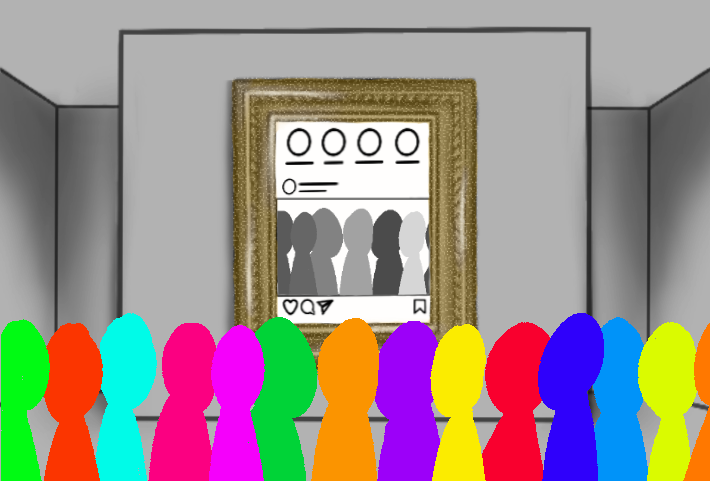
Trying to capture its history through art has proven to be difficult. The risk is if I’m “too creative” with what I’m drawing, the whole concept of diversity is lost.
It’s a tough balance to get right, so I decided to seek another creative’s opinion. I met with artist Hannah Gillingham to discuss the nuances of visually representing diversity in art, and the media’s role in effectively distributing it online.
Hannah focuses on surrealism, a style in which artists play with rationality and what’s beyond it. With that in mind, I decided to begin our conversation on what the style means to her.
“I think for me it’s creating a visual that’s less literal…more abstract, the first thing that comes to my mind when I think of like surrealism is dreamscapes.”
Diversity – an underlying theme in art
Hannah’s work mainly focuses on portraiture, and I want to know if diversity is a natural underlying theme in her work.
“Yeah, basically yes” she responds almost immediately with a slight smile. “I think I’m really drawn to interesting characters and different people. Diversity is appealing to me because I want to capture something different in each portrait. I want to”, she pauses, “my whole thing is trying to capture an essence of someone’s identity or personality if I’m doing just a straight portrait.”
“So yeah, it’s really important that there is diversity. I think that’s what makes a piece of art more interesting as well. I don’t want all my paintings just to be of white people, or just like the same kind of face, no matter what race. Having interesting different characters is like really important. And obviously more important is the fact that other people can see their representation in art. I think that’s just as important as well, not just for like the aesthetic reason.”
For me, the importance of representation in her art is where diversity is most prominent. Being able to see parts of yourself makes art more than just marks on paper, it makes art a safe outlet for others.
Does surrealism offer a deeper insight into diversity, as lines are meant to be blurred when painting in that style?
“I think so, definitely, I haven’t had a lot of experience with it so far, because the surrealism of my work is quite subtle but I think it would offer a deeper insight just because you don’t have to work so literally, you can represent people or individuals as you like. So, you can cover a lot more ground of different identities, difference races with experimenting with like colour or texture so I think there’s a lot more you can explore.”
Shifting views of diversity
Most earlier paintings depicted white figures, predominantly white males. We have come a long way as a society, as art nowadays depicts various figures, ethnicities, and stories.
So, how has the representation of diversity in art changed over the years?
“Art is like a mirror, or it reflects society. So, as history has changed, obviously art has also changed. When society is more accepting of diversity and more open to new ideas and new things, then art reflects that. So, it’s definitely gotten better over the years.
“Obviously there’s still a long way to go, but it is a lot better because if you think right back to the start when they were doing the royal portraits, most of the artists were older white men. And now we have a lot more variety and diversity within the artists.”
Hannah says artists like Frida Kahlo bring diversity to the art world by sharing their experiences and culture in their work.
The media’s role in promoting diversity in art
How does art that celebrates diversity reach audiences?
I wanted Hannah’s opinion on whether the media does enough to promote artwork that portrays diversity. Specifically, if the algorithms push diversity focused art, or hide it instead. The algorithms on social media are hard to navigate; many artists must structure their work around them for publicity, but this can be exhausting.
The artworks I see on social media tend to focus on modern art which causes disagreement unsurprisingly. The whole concept of modern art, where pieces generally lead to people saying, “I could do that”, is misunderstood.
Modern art scares people, because it’s atypical. We have been conditioned to conventionality therefore when that is challenged, we do not know what to think. Modern art opens the door to uncertainty. While this notion doesn’t bode well on paper, anything that generates a point of contention flourishes on social media. So, I led with this, asking whether the algorithm caters to this genre or something else, the something else being artwork with a meaning that doesn’t fulfil social media’s criteria.
Hannah looked puzzled for a second, almost frustrated, then went on to say: “It’s difficult because there’s no way to understand the algorithm because it changes so often. It’s unbeatable, understandably.”
“I’ve given up trying to understand it, even from experience of using it over the years. So it’s hard to know if it’s pushing certain things and not pushing others.”
Hannah mentioned advertising as well as traditional art, saying: “I do feel like there is more diversity, but it’s hazy because, I hate to say it, but I feel like some of it’s done to kind of tick a box because they were kind of expected to. But it has improved. But it’s still a long way to go.”
Tokenism is what I believe Hannah was referring to here, where superficial efforts are made to be inclusive only to create a false appearance of diversity, nothing more.
The power of controversial art
Controversy is conversational, and social media is where this concept thrives. In terms of art, does the media favour art that is controversial, as opposed to art that is personal or has a deeper meaning?
“So, I feel like on social media, yes, it definitely does gravitate towards controversy. But I think it leans towards anything that kind of sparks conversation,” says Hannah.
“It definitely feels one-sided at times because people are much more likely to be a keyboard warrior if they’re angry. And if someone sees something nice, then it’s really sad, but they’re most likely going to internalise that rather than saying it.”
“I think people are more likely to have something to say when it’s a negative comment rather than a positive, which is, I don’t know why people are wired like that. It’s a shame because we need more positivity rather than negativity.”
The takeaway
After our discussion, I had moved away from my initial thoughts about balancing diversity in art. Hannah helped me realise that the answer to this is simply true representation. I do not need to over complicate what I create, I just need to make sure individuals can see even the slightest glimpse of themselves. That is the true beauty of art.
To ensure diversity in art continues to gain prominence, it needs to be treated with respect in the creative process. Moving away from unbeatable algorithms may be part of the solution.