Eurovision, known for its inclusion and diversity, enters its 70th year facing a crisis.
For decades, the contest has offered Europe a stage on which countries present themselves with songs, flags, the promise of unity, and pride. Since 2023, “United By Music” has been Eurovision’s permanent slogan.
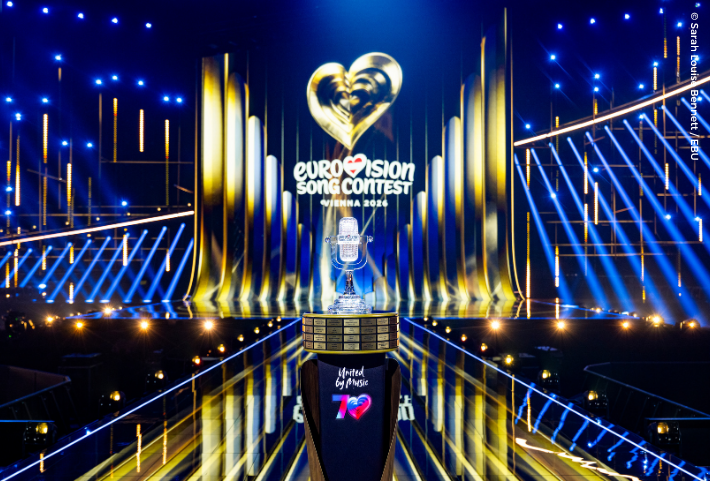
This year, however, Eurovision arrives in Vienna with several countries missing from the lineup. Israel’s continued participation has led Spain, Ireland, the Netherlands, Slovenia and Iceland to withdraw from the contest, making this the largest boycott in the contest’s history. The 70th edition will feature 35 entries, the lowest number of participants since 2003.
The response has also moved beyond the official lineup. More than 1,100 artists have backed calls for a boycott, and Swiss Eurovision winner Nemo returned their trophy in protest. Slovenia will broadcast Palestinian films during the contest, while Belgian civil society organisations create ‘United for Palestine’ as an alternative stage.
The politics of being “apolitical”
Eurovision presents itself as an event that promotes “unity, diversity, and inclusion” with countries representing themselves through different languages and cultures before a mass audience. The 2025 Eurovision contest attracted 166 million viewers across 37 markets. The controversy around Israel’s participation now makes that ideal harder to sustain.
Public broadcasters in Spain, Ireland, and Slovenia have announced that they will neither participate in nor broadcast the contest. Iceland and the Netherlands will still broadcast the show, but they will not be represented on stage in Vienna.
The European Broadcasting Union (EBU) defended Israel’s participation by saying Eurovision is a non-political music event and a competition between public service broadcasters, not governments. In an interview with Nieuwsuur, Eurovision director Martin Green argued that the contest should remain a place where people and artists can meet despite geopolitical conflict. The EBU has also introduced measures aimed at preventing governments and third parties from disproportionately influencing the vote.
For critics, Eurovision cannot separate culture from politics when the contest itself is built around national representation and has, since its creation in the post-war broadcasting landscape, come to symbolise the idea of bringing countries together through culture. That apolitical claim is harder to reconcile with the event’s own role in deciding which symbols are allowed, which broadcasters may participate, and which forms of protest must remain outside the arena. In 2024, organisers said that flags and symbols from non-participating countries would not be allowed, and earlier pro-Palestinian gestures, such as Palestinian banners displayed by the Icelandic performers in 2019, led to sanctions.
Katrien De Ruysscher is the co-initiator of SOS Gaza and one of the organisers of United for Palestine in Brussels, an alternative cultural event created in response to Belgium’s decision to participate in Eurovision. De Ruysscher states that the contest’s inclusive image has “completely collapsed”. “I always refer to the origins of the Eurovision Song Contest,” she said. “It emerged after the Second World War, intending to unite countries within Europe more. If you look at how that is being handled today, then I think there is nothing left of it.”
Eurovision’s double standards
De Ruysscher points to what she sees as a double standard in the EBU’s decisions. “Countries such as Russia and Belarus are excluded because of their war rhetoric,” she said, “while Israel, which is committing genocide and maintains an apartheid regime, is given the opportunity to wave its flag on an international stage.”
After Russia’s full-scale invasion of Ukraine, the EBU excluded the country from Eurovision in 2022. In its 2022 statement, the EBU said that allowing a Russian entry would bring the competition “into disrepute” and emphasised that the EBU is “an apolitical organisation upholding the values of public service”. Israel, however, remains in the contest while committing what many experts have called a genocide in Palestine. The EBU argues that Israeli public broadcaster KAN meets the contest rules and that its relationship with the Israeli government is fundamentally different from the relationship between Russian broadcasters and the Russian state.
De Ruysscher is not persuaded by the EBU’s explanation. “If you exclude one country and not the other, then the story does not make sense anymore,” she says. She also points to the financial side of the contest. “Moroccanoil is Eurovision’s main sponsor which happens to be an Israeli company. What applies to Israel apparently does not apply to others. There is no balance at all.”
United for Palestine as an alternative stage
On the same night Belgium appears in Eurovision, United for Palestine offers a different stage in Brussels. Organised by SOS Gaza BELGIUM, 11.11.11, Vrede vzw, and Intal, the event brings together former Eurovision artists, such as Laura Tesoro and Gustaph, and Palestinian voices such as Bashar Murad. “We did not just want to call for a boycott but also to create something in response,” De Ruysscher says. “The event was sold out pretty quickly, and our petition has over 6,000 signatures, which proves that a lot of people have mixed feelings about this.”
In their petition, the organisers of the event call on Belgium not to participate and urge Belgian national broadcasters VRT and RTBF to keep the contest off air. That pressure is also coming from within the public broadcasting itself. Belgian public broadcaster unions ACOD VRT and CGSP RTBF have called for a boycott. Despite the calls, RTBF decided to send a candidate, and the VRT confirmed it would air the contest.
De Ruysscher argues that public broadcasters and the EBU hold significant power in shaping how the contest is understood and legitimised. “The role of the EBU should not be underestimated,” she said. “They clearly have a very large position of power.” In her view, public pressure on broadcasters is part of how civil society can respond when entertainment and human rights collide. “The cultural boycott is our way of letting our voices be heard and saying we do not agree with this.”
Missing voices
According to De Ruysscher, discussions about Eurovision too often happen around Palestinians rather than with them, which is why she says Murad’s place in the program matters so much. “Palestinians themselves should have the floor,” she said. “It is incredibly important to hear their voices. We like to talk about them, often with a lot of respect and solidarity, but I think it is crucial that Palestinians themselves are given a voice.”
De Ruysscher also sees “United for Palestine” as an attempt to recover what the contest once claimed to be. “My wish is that one day this event could be broadcast by VRT instead of Eurovision: an alternative that goes back to the origin of the contest, one that is about connection, solidarity and finding each other.”
Inclusion under pressure
With fewer participants and heavier scrutiny than usual, this year’s boycott changes the public character of Eurovision. Reuters reported that the contest faces a possible loss of audience and sponsorship if major European backers withdraw, while Eurovision expert Paul Jordan called the crisis a “watershed” moment for the competition. AFP described the 70th edition as “boycott-hit,” with protests expected outside the venue.
Eurovision has long relied on the idea that many different countries can share one cultural space, even when they disagree. This year, viewers, artists and broadcasters are divided over whether taking part in the contest still reflects the values Eurovision claims to represent. Its inclusivity is no longer something the show can simply project through its staging. The alternative responses across Europe also show that the boycott has become a debate about what public culture should do when entertainment, representation and violence meet.