By Ritu Sinha, an independent scholar and researcher in Delhi
The ubiquity of media technologies and their ensuing cultures have perpetually redefined the nature of youth protest in Asia and other parts of the world in the twenty-first century. Indian youth have added the latest chapter to the ‘new wave youth protests’ movement, seeking a transnational global entry into the protests targeting the malfunctioning of basic economic and political structures.
Scholars identify the “Arab Spring” of the 2010s as ‘embodying a cross-border content for other sovereign states’ and a foundation for diverse youth movements in Africa, Latin America, east and south-east Asia in the 2020s.
Like the Arab Spring, the new wave youth protests hinge on the proliferation of social media, which includes references to social, political and economic life in the present era of globalisation and transnationalism. Large-scale, swift participation, political awareness pivoting on democratic ethos, the right to dissent, and inclusiveness have been constant features defining this new wave of protest, distinct from pre-liberalisation students’ uprisings.
Impact of lack of media diversity and representation
The disillusionment with corporate media in countries such as India, in contrast to the inhibited intense personalisation of social media as platforms of interaction and sharing voices of discontent, proved to be a cause of the genesis of such movements. Studies have found that social media plays a crucial role in resistance movements by ‘amplifying marginalised voices, challenging hegemonic narratives’ and fostering global solidarity.
In India, the mainstream media ignored the government’s failure to address corruption in the education sector, one of the reasons behind recent protests. Young Indians were angered over the leak of a national entrance examination paper for admission to medical schools, which led to a test already taken by more than two million students being cancelled and repeated. At least 20 students were reported to have committed suicide as a result. It is not the first time examination paper leaks have caused outrage: they also happened in 2016, 2021, and 2024.
In this latest leak, mainstream electronic media instead focused on the mental health of students, like 18-year-old NEET aspirant Akansha Chaturvedi, Ankita Sangle, Pradeep Meghwal, and other suicide cases. Instead of demanding accountability (in the form of acceptance as a crime, resignation of the minister, or any other form of response), mainstream TV news chose to highlight political fallout or secondary negative effects caused by the paper leak scam. The soft stories of personal experiences of financial strains on parents and socio-psychological pressure faced by students diluted the real hardship of students and allowed corruption to be unseen by the audience.
The widely used Hindi language term by the progressive sections of the society and happily borrowed by the youths, the “Godi Media”, (the media that sits in the lap of the powerful, mainly the present government), elucidate the lack of trust on electronic media and decline in its credibility. The rejection of mainstream electronic media was visible in incidents when reporters from these news channels were discouraged from reporting, and in some cases, OB van drivers were asked by youths not to park around the protest site for news coverage.
The exception was the print media, which indicated that television news was one of the causes of resentment amongst youths. As the New India Express wrote, a casualty of the protests could be television news media, a once respected institution which youth no longer relate to. “One India watched edited television bulletins and another India watched thousands of first-person videos. They were not consuming the same reality.”
The rise of “the cockroaches”
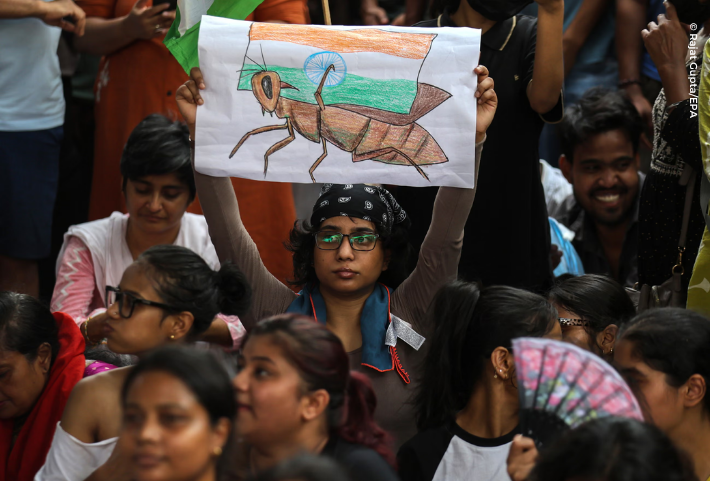
The protesters, angry over the examination paper leaks and levels of unemployment which are carving out bleak futures for youth, describe themselves as the ‘Cockroach Janta Party’ (CJP). Created by Boston-based Abhijit Dipke, the CJP was a satirical social media initiative in response to the derogatory term ‘Cockroach’ used for their generation by the Chief Justice of India.
As one protestor said, India witnessed “something unique happening after several years” when youth marched on the streets motivated by their digital screens.
Shouting slogans against corruption and failure of the National Testing Agency (NTA) in conducting national exams such as NEET (National Eligibility cum Entrance Test), the defiant young non-violent protestors led by Gen Z marched with humour, joy and satire as their weapons of resistance, as they demanded accountability from the Modi government.
Modi’s BJP established itself as a majority party in 2014 on the promise of corruption-free shresht viksit bharat (a great developed nation) and vouched for sabka saath sabka vikas aur sabka vishwas (support of all, development of all and trust of all).
On July 20, it was exhilarating to see a huge throng gathered at Jantar Mantar, the protest site, joined by many youth protesters who marched toward central Delhi in the presence of a heavy deployment of the Rapid Action Force, paramilitary forces and Delhi police.
Despite being labelled by mainstream media as “terrorists” and “misguided anarchists”, the protestors did not appear “unruly or radicalised youth”. Many hundreds marched from different directions to become thousands at the site where Neha Bora, a JNU student and all-India president of AISA (All India Students’ Association), along with Manish Kumar and Aameen Amitoj, were on stage fasting in solidarity with hunger striker Sonam Wangchuk, who was demanding the education minister’s resignation.
However, during the protests, they faced a police crackdown, with dozens wounded when police used batons and tear gas on them.
Controlling the narrative
In response to the protest, Prime Minister Modi resorted to victimhood in his message. Visualising a threat to his government, he infantilised the youth while conveniently refusing to respond to the nationwide police brutality, which also resulted in the detention of hundreds of students and the harassment of Muslim youths.
The protesters turned to social media to demand accountability, posting videos of the alleged abuse and mistreatment of protesters which went viral. Individual distress, trauma, and narratives on state atrocity flooded social media, sparking a more resolute show of strength for the nation and youth. The protesters mocked the government creatively through memes, humour, and online resistance.
Liza Christopher, a queer neurodivergent student, could not sleep on the night of the 20th as she was swamped by videos showing the police crackdown. Feeling that the protest area was like a war zone, like many others, she returned to the protest the following days. Despite her doubts about the government’s response to students’ demands, she firmly trusted “whatever is happening here will shake the police, the government and they will know they cannot mess up with our lives anymore”.
The unabashed emotional articulacy, profound expressiveness and concerns of their lives in danger indicated their vulnerability yet robust will for reimagining a democratic, inclusive India with citizens’ rights. It stimulated the Alpha (School kids), small “cockroaches”, along with older generations to participate and voice discontent against bad governance. Many mothers joined the protest with their children, and many facilitated the movement by providing daily requirements of food and water.
The almost two-month-long action, including hunger strikes and the march to parliament, produced a victory for the movement, with the resignation of the education minister, compensation to families of the paper leak suicides and the passing of a bill against the paper leaks.
Tech as a tool of resistance
What is striking about this movement is the hope being inspired via interactive digital communication, which provides a sense of freedom where the culture of protest and dissent hinges on the mightiness of technology.
The creation of tech-driven techniques and tools of resistance has generated information-based awareness and imagery encouraging agency to express disgust and rage in the form of protest. It has ushered in what scholars have rightly called an era distinct from “the whole world is watching” phase. It is no longer about passively receiving images on screen but about possessing the ability to counter them and interact incessantly. The agency of the audience and their participation in the digital age is the game changer in the new-wave youth protest movements.
The ability of social media with tools such as hashtags (eg.#modi#cjp#rap) and certain symbols to present a merged coordinated narrative facilitate such movements, though differences of ideologies are much visible on ground. Gen Z in India was creative with memes, rap music, posters and slogans expressing resentment over their unheard voices.
Inclusion and diversity
It is also showcasing inclusion and diversity.
In India, Gen Z’s collective frustration over misgovernance, solidarity over issues concerning youth, as well as unanimous faith in tech-driven techniques, is widely misinterpreted as homogeneity. The similarity of language and ability to create digital content appeared to fuse regional, caste, religious, and class identities. However, it is important to note that the movement is composed of a variety of groups with diverse slogans. It is vital to note that although social media manages to present a unified narrative that provides muscle to the movement, embedded and systemic inequality persists in India.
Deep-rooted differences continue to define social lives in present India as the social structure defined by primordial ties such as caste, class, gender and religion, intersects with the modern structures of the nation- state to make it systemic. It is reflected in opportunities of education, discrimination in access to private English education and struggles to carve out an economically stable future, amidst which such corruption in national examinations affects many. Beyond losing one opportunity among others, for most, it is the only chance available economically and socially to upgrade their lives on the social ladder. It is an opportunity to fulfil desires and to prove their intellect on par with many middle-class, upper-caste students (with the privilege of schooling and less economic strain to pursue their futures). The dropout rate in secondary-level education, according to government records, is 17 per cent, indicating the social pressures and limited opportunities to acquire basic qualifications for writing an entrance test for medical schools.
Social media did create empathy for dying students, building unified sentiments against the system’s frivolity. Yet despite that, inclusivity remains a wider issue in countries with colonial pasts in South Asia due to a variety of social contexts still based on differences and exclusion.
Nevertheless, students and leaders of the CJP have countered attempts to ingrain politics of hatred and division in India based on communalisation. Such protest movements demonstrate that youth are willing to fight against injustices and attempts to curtail freedom and inclusivity.
The views and opinions expressed in this article are solely those of the author and do not reflect the official policy or position of the Media Diversity Institute. Any question or comment should be addressed to [email protected]