By Clarice Tchatat
Introduction: The Reality Behind Africa’s AI Hype
Across newsrooms from Dakar to Nairobi, artificial intelligence is no longer an abstract promise framed by Silicon Valley. It has arrived on reporters’ desks as an immediate, messy reality. While global tech executives market commercial language models as democratic equalisers, journalists on the ground face a starker truth.
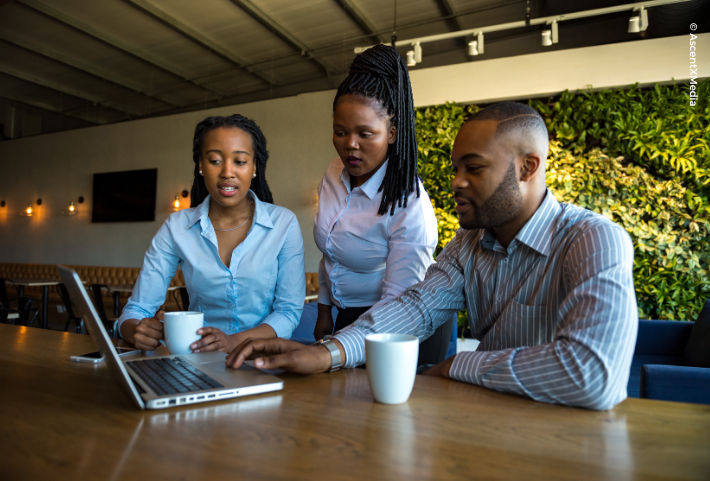
AI does not land in a vacuum. It enters a continent where media operations fight tight budgets, unreliable digital infrastructure, and historical information dependencies. In one light, these algorithmic tools offer real muscle: helping small teams sift through massive document leaks or reach rural communities in native dialects. In another, they threaten to reinforce linguistic exclusion, fuel election-season manipulation, and turn African media professionals into cheap labour for Western technology firms.
For the Media Diversity Institute and newsrooms committed to public-interest reporting, the task is straightforward. We cannot afford passive adoption or empty technophobia. We need a hard-headed look at who controls these systems, who benefits from them, and how African journalists can maintain editorial independence in an automated media ecosystem.
Language Barriers and Algorithmic Erasure
How commercial LLMs ignore African speech
Pluralism in journalism depends directly on language access. Africa has more than 2,000 living languages, rooted in rich oral traditions and distinct regional dialects. Yet systems like ChatGPT, Claude, and Gemini were trained almost exclusively on English, Mandarin, and Western European text.
This design flaw creates a silent form of exclusion. Languages like Swahili, Wolof, Lingala, Bambara, and Pidgin are routinely treated as edge cases by commercial developers. When processing these tongues, natural language processing models either fail completely or churn out distorted, inaccurate translations.
For millions across sub-Saharan Africa who consume news orally or through local community broadcasts, this gap is dangerous. When AI tools cannot accurately translate or transcribe regional languages, large segments of the population are left outside verified news distribution, creating fertile ground for unverified rumours.
Grassroots answers: The Masakhane network
Rather than waiting for Silicon Valley to update its priority list, local researchers and journalists built their own alternative. The Masakhane collective (“We build together” in Zulu) operates as an open-source movement designing language-processing tools specifically for African linguistic realities.
Reporters play a direct role in this effort. By feeding national radio scripts, interview archives, and print reporting into open repositories, newsrooms help build ethical, representative datasets. In Kenya, Senegal, and Uganda, community outlets are now testing automated translation and voice tools tailored to local listeners. Briefs written in English or French can be converted into accurate audio in Wolof or Swahili within minutes, giving non-English-speaking communities access to verified journalism.
The Human Cost of Clean Tech: Nairobi’s Click Workers
The Sama and OpenAI investigation
The popular narrative surrounding artificial intelligence portrays it as clean, weightless software. The reality on the ground relies heavily on underpaid human labour. Between November 2021 and February 2022, OpenAI contracted Sama, a San Francisco data outsourcing firm operating in Nairobi’s Kilimani district, to build safety filters for ChatGPT.
To stop the chatbot from outputting hate speech, graphic violence, or illegal content, human workers had to manually read, categorise, and flag tens of thousands of violent text snippets.
In January 2023, investigative reporting exposed the conditions inside Sama’s Nairobi office:
- Poverty pay: Content moderators earned between $1.32 and $2.00 an hour (170 to 260 Kenyan shillings) for gruelling nine-hour shifts.
- Severe psychological strain: Workers were forced to review 150 to 250 violent text fragments daily, covering extreme graphic abuse, murder, and self-harm.
- Negligible support: Mental health support was minimal and primarily used by management to measure worker output rather than provide care.
The company responsible for the workers denied those claims.
Labour organising in East Africa
Following the fallout from the investigations, Sama terminated its moderation contracts in February 2023. The workers themselves took action. In May 2023, led by former moderator Richard Mathenge, more than 150 tech workers formed the African Content Moderators Union in Nairobi. They launched landmark lawsuits against Sama and Meta in the High Court of Kenya, challenging unfair labour practices, union-busting, and inadequate mental health provisions.
For investigative journalists, reporting on these outsourcing pipelines is not just a tech story. It documents a modern form of labour exploitation where Silicon Valley’s multi-billion-dollar valuations depend on low-wage work in the Global South.
Synthetic Disinformation and the Battle for Trust on WhatsApp
Audio deepfakes in electoral campaigns
In most African countries, political news does not break on traditional websites or official social channels. It spreads inside closed, encrypted messaging apps, primarily WhatsApp. In these social channels, unverified claims move rapidly beyond public oversight.
Cheap, consumer-grade generative tools have lowered the barrier to political manipulation. Anyone with a smartphone can now clone voices or fabricate video clips for a few dollars. During recent elections in Nigeria, Senegal, the DRC, and Mali, fake voice notes allegedly showing political candidates conspiring or making hate speeches were circulated hours before voting opened.
When public trust in state institutions is already fragile, believable audio fakes deepen voter cynicism and increase the risk of real-world tension.
How African newsrooms are fighting back
Instead of retreating, fact-checking desks across the continent are using specialised digital tools to counter synthetic media. Organisations like Africa Check, PesaCheck, and Code for Africa employ voice-frequency analysis and reverse-image search models to verify suspicious files.
Crucially, these newsrooms adapt their distribution to match how people actually consume media. Verified debunks are recorded as short, local-language audio notes and sent directly back into the same WhatsApp groups where the original fakes circulated, closing the information loop with verified facts.
Cutting Through Secrecy: Data Mining for African Investigations
Levelling the resource field
African investigative desks routinely tackle complex cross-border financial crime with a fraction of the budget available to Western outlets. Uncovering procurement fraud or tracking offshore capital requires sifting through thousands of scanned pages, government registries, and court filings.
Machine learning and optical character recognition (OCR) provide a practical force multiplier here. Small investigative teams can now parse, index, and query massive, unstructured document dumps in days rather than months:
- Archival digitisation: AI OCR tools extract text from scanned physical government papers, making historical archives instantly searchable.
- Public procurement audits: Algorithms trained on tender records flag suspicious patterns, such as shared corporate addresses, inflated unit costs, or unusual contract award times.
- Financial flow tracking: Networks like “the Cellule Norbert Zongo pour le Journalisme d’Investigation (CJAO) use graph analysis software to trace complex ownership structures and offshore accounts linked to capital flight, which drains over $88 billion from Africa each year.
These tools do not replace ground-level reporting or confidential source work. Instead, they provide investigative journalists with hard, document-backed evidence that holds up under scrutiny.
Action Plan for African Editorial Sovereignty
If artificial intelligence is to serve public-interest journalism across Africa, newsrooms and media support organisations must stop reacting defensively and start building clear operational policies. The focus should centre on three practical priorities:
- Sovereign Datasets: Build open, royalty-free African-language repositories (text and audio) to train representative algorithms, rather than relying on commercial Western models.
- Clear Ethical Protocols: Enforce strict human-in-the-loop review, source protection, and full public disclosure whenever AI tools assist in reporting or visualisation.
- Shared Tech Resources: Establish regional data hubs and shared open-source toolkits to ensure small investigative desks maintain access to advanced analytical software.
1. Build local language infrastructure
Media houses, academic institutions, and tech collectives must collaborate to produce high-quality, open-access language data. Without locally curated datasets, African journalism will remain dependent on imported, biased software.
2. Enforce clear newsroom ethical guidelines
Outlets must set explicit boundaries for automated tools. Guidelines should mandate that no machine-generated content is published without human verification, that source identity is never fed into external commercial servers, and that audiences are informed when AI assists in research or visualisation.
3. Demand transparency from global technology platforms
International press freedom groups must push tech companies to invest in local-language moderation, pay fair wages to data workers in regional hubs, and open platform APIs so researchers can audit algorithmic bias in real time.
Journalism First, Technology Second
Artificial intelligence is neither a magical fix nor an unstoppable threat to African press freedom. It acts as a mirror, sharpening existing industry conditions: where newsrooms are underfunded and precarious, automation accelerates low-quality reporting. Where journalists maintain strong ethical standards and investigative independence, AI becomes an effective tool for accountability.
African journalism has a long tradition of adapting to information monopolies, from independent print presses to community radio networks. The challenge presented by generative AI is no different. By combining digital tools with rigorous ground-level reporting, African journalists can protect public-interest news and demand fair treatment from global tech platforms.