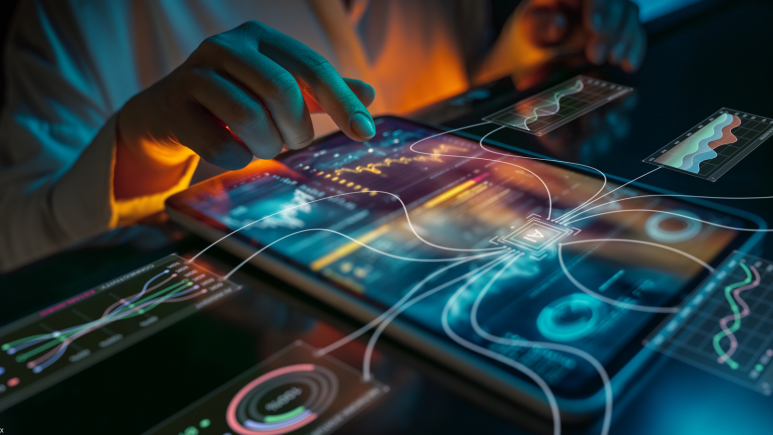
Artificial intelligence can now describe an image to a blind journalist, read a screen, review a design and search thousands of documents. Yet a disabled journalist may still be unable to reach the studio because the lift is broken, publish a story because a button has no accessible name, or convince an editor that the tool is assisting rather than replacing them. The limit may no longer be what technology can do, but what the institution can imagine.
An in-depth report by Ahmad Manenah
Throughout my years in journalism, I developed a small habit that was also slightly embarrassing.
At the end of some files I sent to an editor or publisher, I would add a note explaining that I am a blind journalist and that my screen reader does not always allow me to verify the document’s final visual appearance.
The problem was not the article. I knew what I had written, why one paragraph came before another, and I could defend almost every sentence. The problem was something that sounds trivial until it becomes part of how your professionalism is judged: Is the headline in the right place? Is the paragraph aligned correctly? Did the table break? Did the PDF export look the way I intended?
Even text direction could create an absurd situation. Arabic is written from right to left; English, the opposite. In the rush of a newsroom or studio, I could write an entire Arabic text while the page was visually set left to right, without my screen reader making that fact clear to me.
I knew the words were right. I did not always know what they looked like.
Sometimes all it took was a colleague opening the file for me to realise, from the tone of their voice before they said anything, that formatting had decided to embarrass me that day.
Then Artificial Intelligence arrived.
For perhaps the first time, I could explain to a tool not only what I wanted to say but how I wanted it to look: this is a headline, this is body text, put this information in a table, Arabic runs right to left, preserve this hierarchy, then give me a finished file that I can send knowing – far more confidently than before – how it will appear to a sighted reader.
For me, that was not a revolution in writing. It was a revolution in presenting what I had written myself.
The irony appeared almost immediately. When some colleagues see that a file was formatted or exported with AI assistance, the question can shift quickly from “How did Ahmad finally gain control over the visual presentation?” to “So what did Ahmad actually do?”
As if AI is simply another productivity tool when a sighted journalist uses it, but evidence that the tool may be doing the work when I use it.
Sometimes it feels as though a disabled journalist is expected not only to complete the task, but to complete it by the most difficult route in order for their competence to remain believable.
I do not want AI to write for me. In fact, I argue with it a lot.
I use it for programming, organisation, brainstorming and visual tasks I cannot access directly. But I try to keep the language, angle, position and final editorial choices under my control; I review the result, reject it, send it back and repeat the process until it resembles what I actually want to say.
Other uses matter more to me than generating a paragraph: describing a video shot, reading a screenshot, telling me whether a design contains an error, explaining the relationship between visual elements, reviewing visual material before publication, or helping me identify a problem I could not see.
For much of my career, many of those tasks were effectively reserved for sighted journalists.
That is why, for the first time, the idea of being a “full-spectrum journalist” feels closer to reality: a journalist able to write, research, edit, work with sound and images, and analyse material, rather than having professional roles divided according to what their eyes can access.
Being seen as a journalist not a disabled journalist
And yet none of that progress has solved my central problem: trust.
When I show people my portfolio, I often hear praise, sometimes surprise, and occasionally something close to disbelief. Yet many of the professional opportunities I have received over the years have been connected to the fact that I am a blind journalist more than to the fact that I am a journalist.
“Write something for us about disability.” “Come record the interview; your Arabic is good and you have a radio voice.”
A real reporting assignment? An investigation? A complex file? Full editorial responsibility? I can almost count on one hand the editors who treated me that way. Three.
I am not claiming that my experience is a statistic about Arab media. It is, however, more than enough reason to ask the question.
Years ago, if I needed to know what was in an image, I needed a sighted person. Today I can send it to an AI system and ask. Not only: What is in this image? I can ask: Where is the person standing? What is behind them? What is journalistically significant about the scene? Is there small text? Is there anything I should notice before using it in a story?
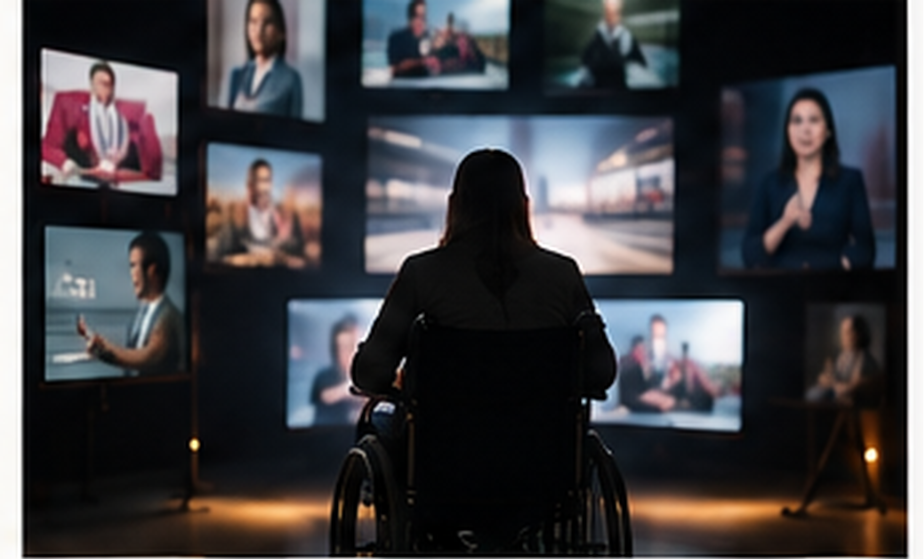
AI-generated editorial illustration for this article; it is not a documentary image of any interviewee.
How the assistant described it to me: The image shows a person from behind, seated in a wheelchair at the centre of a dim newsroom and facing a wall of broadcast screens. The person’s face is not visible, so their identity, age or gender cannot be determined reliably. The screens are arranged at different heights and show presenters, guests and outdoor scenes; on one screen, a woman appears to be using her hands in a way associated with presenting or sign-language interpretation. Cool blue light comes from the screens, while a low amber glow near the floor leaves the person and wheelchair in silhouette. Compositionally, the user—not the screen—is placed at the centre: technology surrounds them from every direction, while the image leaves open the question of whether those interfaces are actually designed to be accessible. No legible text or identifying detail in the image should be treated as documentary evidence of a real person or newsroom.
This is not a nice convenience. It is professional independence.
But I may finish analysing the image, open the website where I am supposed to publish it, and then be unable to find the upload button.
AI can describe the world to me, only for me to be blocked by a button that nobody gave an accessible name a screen reader can understand.
The problem does not end with a publishing system. A modern journalist works with chatbots, fact-checking services, open databases, maps, interactive graphics, search and archiving systems, and dashboards. Some mapping tools are built around a fundamentally visual understanding of spatial relationships. A database may be accessible until the moment the information becomes an interactive chart. A chatbot may work perfectly with a screen reader while its file-upload or identity-verification window does not.
Technology here is not one thing that can simply be labelled “accessible” or “inaccessible”. It is a chain. One inaccessible link can be enough to break the whole thing.
One in six is not a marginal market
The World Health Organization estimates that 1.3 billion people experience significant disability – 16 per cent of the world’s population, or one in six people.
One in six. Too large a number to leave at the end of a design meeting under “we’ll think about accessibility later”.
Yet entering the labour market does not mean entering it on equal terms.
In August 2024, the International Labour Organization published findings from a working paper on employment and wages among people with disabilities. It found that disabled workers earn, on average, 12 per cent less per hour than other workers. More importantly, three-quarters of that gap – around nine percentage points – could not be explained by differences in education, age or type of work.
A person may therefore reach the labour market without necessarily reaching the same starting line.
Media adds another layer. Journalism is no longer a notebook and a pen. It is a content-management system, dashboard, studio, editing software, design platform, video meeting, archive, internal communications tool, database, map, online form, publishing service, and now an expanding set of AI tools evolving faster than many newsrooms can write policies for them.
One failure is sometimes enough to turn a job into a chain of requests for assistance.
The story that cannot be reached – and the journalist who cannot get in
In a study titled “Accessibility barriers in Arabic news websites for visually impaired users: a mixed-method evaluation approach”, researchers Duaa AlSaeed, Hind Alotaibi, Hend Al-Khalifa and Nadia Al-Ghreimil evaluated the most visited news website in each of 19 Arab countries using the TAW accessibility tool, alongside semi-structured interviews with six visually impaired users. The study was published online in October 2024 in Universal Access in the Information Society.
The results were not a minor problem affecting one or two websites. The researchers found failures across all four WCAG 2.1 principles: 45 per cent of recorded errors were related to Perceivable requirements, 38 per cent to Operable, 14 per cent to Robust, and 3 per cent to Understandable.
When the errors were classified by type, 40 per cent involved links and navigation, while 31 per cent involved images without alternative text. Blind and low-vision interviewees also reported problems with navigation, multimedia and site organisation.
The study effectively asks: Can a disabled user reach the news? The question that preoccupies me sits on the other side of the screen: Can a disabled journalist make the news?
If the final product has these problems, what about the systems behind it? Can a blind journalist upload an image and change its caption? Can they tell whether the story has been saved? Does the screen reader announce an error? Can they operate the analytics dashboard? Can they review a video before pressing Publish?
I have had articles published that I later could not read independently in their published form because the website itself did not work properly with a screen reader.
The contradiction is even sharper inside the newsroom. I have worked in advanced media environments that rely on dashboards and editorial content-management systems, yet screen-reader access was not part of the calculation when those environments were designed or selected.
I worked inside the institution. Some of the institution’s tools behaved digitally as though I did not exist.
There is an important difference between news being accessible to disabled people and the production of news being accessible to them. The first determines who can read. The second determines who gets to be a journalist.
The lift that carries everyone except the opportunity
Rami Zaloum is not blind. That matters, because a discussion about digital accessibility can too easily reduce disability to a screen-reader problem.
Rami is a journalist and radio presenter with a mobility disability. When I asked about his most significant barriers, he put the physical environment first, alongside behavioural barriers and a lack of acceptance from some colleagues. In his experience, a repeatedly broken lift sometimes prevented him from reaching the studio to record his programmes.
The journalist is ready. The programme is ready. The studio is ready. The lift is not.
One mechanical component can decide who reaches the microphone.
Rami also described a different experience: not being given responsibility for managing a training project.
Beyond the physical lift, another, less visible lift appears: the lift of stereotype. It may carry someone from “the person we include” to employee status, then stop before the floors marked authority, leadership and decision-making.
One experience alone cannot prove that a particular decision was caused by disability. But it makes the question legitimate: At what point does professional assessment stop being about what someone can do, and when does the body begin to enter the judgement of whether they are considered ready for responsibility?
For Rami, new technologies have made editing and production easier. Yet he describes some participation of disabled people in media institutions as still “symbolic”.
Symbolic is a word that will return more than once in this story.
Rawan did not wait for the key
Rawan Barakat’s experience takes the issue somewhere else. Rawan is a blind media professional, founder and director of Raneen Foundation, and host of the Sahyat podcast.
When we spoke by phone, her problem did not begin with a piece of software that failed. It began with a look – with the question that enters the room before the person: Can she really do it?
Rawan spoke about institutions that still do not fully believe in the capabilities of persons with disabilities, and about stereotypes that arrive before professional judgement.
That kind of barrier is harder than an unnamed button. Code can be fixed. There is no keyboard shortcut for removing a stereotype from a manager’s mind.
What interests me most in Rawan’s experience is that she did not remain in the position of waiting for an institution to let her in. She became a decision-maker herself.
That reverses the conventional language of “including” disabled people. We spend a great deal of time asking: How do we hire them? How do we prepare the workplace? How do we give them an opportunity?
What happens when the disabled person holds the key? When she runs an organisation, chooses the team, decides what the product looks like, and determines for herself what she needs in order to work?
At Raneen, Rawan gained greater control over how work itself is organised, rather than constantly being required to adapt to a system someone else designed.
AI expanded that space. Image description and tools for interpreting designs and visual content reduced her reliance on a sighted intermediary for parts of her work.
I dislike the romantic line that AI has “given blind people eyes”. My eyes are not a technology project waiting to be completed.
The more accurate point is that these tools reduce the number of times we have to ask another person: “Can you tell me what’s here?” That is independence.
But AI does not make a studio physically accessible. Nor does it prevent an institution from using a disabled employee as public-relations evidence that it is “inclusive”.
Rawan was clear in rejecting that symbolic presence: a person should be genuinely part of the work, production and decision-making, not someone who is summoned when disability itself becomes the subject.
“Poor thing”… then “Amazing!”
Osama Essa sits on the other side of the table in this story. He is the founder and director of ShezoMedia and an employer who has worked with people with visual and mobility disabilities.
When I asked what most often prevents institutions from hiring and genuinely including disabled people, he answered: “Fear of responsibility and limited knowledge of rights.”
Fear of responsibility is an important phrase. An employer does not always have to say: This person is not competent. It may be enough to imagine the problem before it happens: What if they need something special? What if there is an emergency? What if we do not know what to do? How much will it cost?
In Osama’s experience, most internal adjustments were simple. The greater difficulty appeared in the building itself and the lack of sufficient physical access, particularly for people with mobility disabilities.
But his strongest phrase was neither technical nor legal. It was deliberately colloquial. Real inclusion, he said, means that a disabled employee is like every other colleague: rights, duties and responsibilities. What they try to resist, he called the “poor thing / amazing!” syndrome.
“Poor thing” when we look at the person. “Amazing!” when they do something ordinary. Then we behave as if inclusion has been achieved.
That can extend to the aesthetics of coverage. A non-disabled television presenter may receive meticulous attention to lighting, clothing, hair, make-up, posture and camera angle.
But when a disabled person appears, their presence itself can become the event. They may be placed in front of the camera in ways that make the scene appear more “human”: the wheelchair, the cane, the Braille page in hand; while questions about how they want to look, how they perform on camera, or how they want to present themselves become secondary.
This is not an argument for hiding a cane or a Braille page. It is an argument that the person deserves the same professional attention the organisation would give anyone else appearing on camera.
Inclusion is not making disability visibly prominent. It is giving the person the same right to decide how they are seen.
When I asked Osama about purely performative representation, he used a shorter word: “Décor.”
The problem is in the architecture of the room
Sameer Semreen, a senior presenter at Al Jazeera Media Network who delivers news bulletins in sign language for deaf audiences, shifts the question from individual experience to institutional design.
In his responses, he did not restrict barriers to the building. He discussed digital tools, editorial meetings, training, studios, internal communications systems, and the assumptions people make about what a disabled person can do.
The question changes here. Instead of asking: What special adjustment does Ahmad, Rami or Rawan need? We can ask: Why was the institution designed from the beginning on the assumption that everyone sees, hears, moves and interacts in the same way?
The first question makes the employee the exception. The second puts the design itself under investigation.
For Sameer, inclusive media is not created by adding an accessibility service at the end of the process. Accessibility has to become part of how the organisation thinks, plans, produces and operates.
Dr Ghanimeh El-Taweel, an Affiliate Instructor at Hamad Bin Khalifa University’s College of Humanities and Social Sciences and a researcher specialising in media accessibility, reaches a similar point from a rights-based angle. In her responses, she highlighted the way disabled people’s qualifications and expertise can be discredited, while the accommodations required for full participation are often treated as a burden.
Sometimes the problem may be less the actual cost of access than the size of the cost institutions imagine before they ever try.
Everyone uses AI – until a disabled person does
It is difficult today to walk into a newsroom, agency or content company without finding someone using AI in some form: transcription, preliminary research, summarisation, translation, brainstorming, coding, design or data analysis.
It has become part of contemporary work, whether we like it or not.
Yet I notice a particular contradiction in how disabled people are judged for using it. When a sighted person uses AI, they may be described as faster or more productive. When a blind person uses it, the question can quickly become: Is he doing the work, or is AI doing it for him?
As though the same tool that increases everyone else’s productivity somehow subtracts from my competence. In many of my uses, the system is not replacing my thinking; it is removing a visual barrier between me and the task.
Employers can see the economic value as well. Osama said assistive technologies and AI had benefited both disabled workers and the organisation, sometimes saving time, effort and money.
But AI can also reproduce the same problem.
In August 2026, researchers Sabrina Haque and Christoph Csallner published an empirical study of visual accessibility issues in AI developer tools. They analysed 2,652 issue reports and discussions from five ecosystems: GitHub Copilot in VS Code, Cursor, Claude Code, OpenAI Codex and OpenCode. From that pool, 600 cases were identified as clear visual-accessibility reports involving screen readers and assistive technologies, visual presentation and contrast, and readability, scaling and interface controls.
The study is not about journalism, and that distinction matters. Its relevance is that it exposes a common assumption: a “smart” product is not necessarily an accessible one.
A system can be capable of generating an entire software programme and still present a blind user with a button that has no name. Brilliant on the inside. Stupid at the door.
When a platform like that becomes part of the conditions of employment, accessibility is no longer only a product-design issue. It becomes a labour issue.
The second job nobody sees
There is another cost that is difficult to put in a statistical table: time.
Five minutes to find a workaround. Ten minutes to move the text into another programme. A call to a friend to read something. A message to a colleague: “What are you seeing on your screen?” A search for an alternative because the official tool does not work. Reopening the page in another browser. Trying to get through a CAPTCHA. Waiting until a sighted person is available.
Each incident seems small. Add them up over years, and you have a second unpaid job: making the work environment usable.
You could call it, metaphorically, a disability tax.
It does not appear on a payslip. It is not recorded in a performance review. A manager often has no idea you paid it.
You pay with time, concentration and independence – and sometimes with your mental health and confidence.
Especially when you know perfectly well that you can do the task, and what stands in your way is not a gap in your knowledge but a design decision made by someone who never imagined you would reach that screen.
That is why saying that two people completed the same task does not tell the whole story. The question is not only: Did they finish? It is: How much did each of them have to pay to get there?
From the lift to HTML
After all this research, it is tempting to ask for the “biggest barrier”. I do not think there is one.
For Rami, it may be a lift. For Rawan, a stereotype that reaches the meeting before she does. For me, an upload button my screen reader cannot name. For an employer, fear of a responsibility they do not understand. In another organisation, it may be a platform proudly purchased because it is “AI-first” without anyone in the procurement meeting asking one small question: Can an employee using a screen reader actually operate it?
The forms are different. The logic is the same: something was designed for one imagined kind of human being, and everyone else was asked to adapt.
The social model of disability has made a simple point for decades: a wheelchair user is not prevented from entering a building by the wheelchair as much as by the staircase when the staircase is the only route.
The modern newsroom has not eliminated staircases. Some of them are simply made of HTML.
We are not victims – and we are not heroes either
Media has a long and strange relationship with disability. The person is either a victim or a hero: the unfortunate person who needs help, or the inspirational figure who has “overcome” disability.
Between those two characters, someone far more ordinary disappears: the employee.
The journalist who is good at some things and bad at others. Who makes mistakes. Is late sometimes. Needs training. Wants a better salary. A promotion. A harder assignment. And may become a manager.
When Osama says inclusion means rights, duties and responsibilities, he moves the conversation from pity to work.
When Rawan becomes a decision-maker, she moves from being a “beneficiary of inclusion” to someone who shapes the institution itself.
When Rami faces a broken lift, his experience reminds us that an entire discourse on diversity can collapse in front of a piece of metal nobody thought to maintain.
Perhaps we do not need another hero story. We need an institution that treats our presence as ordinary enough to give us the right to fail in ordinary ways too.
Who needs to adapt now?
For years, the burden was placed on us: learn the technology, memorise the shortcuts, find a workaround, ask for help, change the programme, adapt, prove you can do it – and then prove again that you can do it without inconveniencing everyone else too much.
AI has changed a small but important part of that equation. Technology itself has begun to adapt to us.
I can ask it to convert information from a form I cannot access into one I can: image into description, scene into words, audio into text, text into structure, interface into explanation.
That does not solve discrimination. It does not repair the lift. It does not make a manager more aware. It does not write a fair hiring policy by itself.
But it quietly removes one of the oldest arguments: “They won’t be able to do it.”
In more and more situations, we can. New technology is making professionally possible things that were not available to us only a few years ago.
That is why the question that interests me is no longer: Can a blind journalist use newsroom tools?
The question is: Why can’t a newsroom trust a blind journalist?
Not: How can a disabled person keep up with the institution?
But: How long can an institution keep demanding that human beings adapt to it while machines themselves are learning to adapt to human beings?
Artificial intelligence is learning at extraordinary speed to see, hear, read, describe and speak.
I do not need the newsroom to be that intelligent. I need it to pass a simpler test: see the journalist before the disability; give them the assignment before the applause; and open the door without requiring them, every time they enter, to prove that they deserve to be inside.
Ahmad Manenah is a journalist and podcast producer based in Amman, Jordan.
AI tools supported accessibility, formatting, research organisation, visual-content interpretation, source checking and editorial assistance. They did not replace the reporting, interviews, source selection, journalistic judgement or final editorial decisions.
The views and opinions expressed in this article are solely those of the author and do not reflect the official policy or position of the Media Diversity Institute. Any question or comment should be addressed to [email protected]