Peru’s President Dina Boluarte has been impeached by lawmakers, following protests and outrage over a surge in crime.
Across the month of September, youth protests took over much of Peru, concentrated particularly in the capital Lima. According to a local human rights NGO, the National Human Rights Coordinator (CNDDHH), as of the 30th of September 19 civilians were injured in the protests. This particular wave of action was sparked on the 5th of September, when the deeply unpopular government of Dina Boluarte enforced mandatory “contribution to private pension funds” for all adults. This was done during a time where youth unemployment in the country is around 30 per cent and there is mass insecurity and criminality across many of Peru’s largest cities.
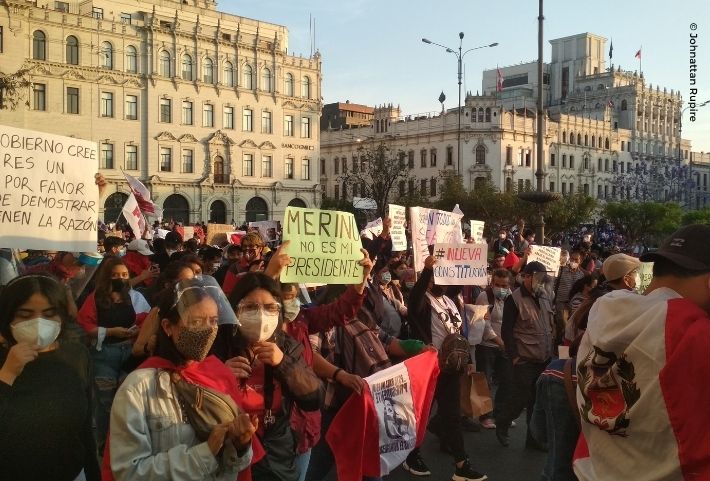
People under the age of 30, commonly described as Generation Z, were the group of protesters which took the media spotlight in Peru. This brought comparisons to the recent protests in Nepal in September 2025, and Madagascar and Morocco in October by Time magazine. The similarities mentioned are spontaneity, a leaderless social movement at the forefront of the revolts, a violent governmental crackdown, and the sheer speed of its mobilisation.
Furthermore, ‘Gen Z’ is at the core of the media representation of all these protest movements, including Peru. Common imagery is that of young people who feel underrepresented and use symbols and insignia previously never seen before in the political landscape. For example, Reuters reports that in Peru, the use of the pirate flag, with a skull in a straw hat has become “a common feature in the demonstrations in Nepal and Peru”. This is a symbol from the popular Japanese anime One Piece. France 24 writes “Gen Z youth in Indonesia, Nepal, the Philippines, Madagascar, Morocco ” have been using this symbol, during anti-government protests.
The use of the One Piece flag by Gen Z-led protests in Peru has been mentioned by Reuters, DW, CNN and many other smaller publications in relations to this wave of protests. The current English-language media narrative seeks to group all these disparate movements together, using the One Piece flag as a unifying symbol. However, this has unfortunately ignored the historical discontent in Peruvian society, particularly regarding often overlooked groups in the country.
Peru – One Crisis after Another
Peru has been engulfed in a series of deep institutional and corruption crises. The starting point can be traced back to the 2018 election of President Martin Vizcarra, who won support as a centrist, unifier and opponent to the authoritarian tendencies of the Congress. However, in 2020 President Vizcarra was impeached for corruption. From 2020 to 2023 Peru had four presidents ousted by Congress or made to resign. Dina Boluarte was elected on a platform of social justice and moderate policies to unite the country in 2022. However, her presidency was marked by a popularity rate of 3 per cent as of September 2025, increasing authoritarianism and violent crackdowns against protesters.
Indigenous Peruvian people, and poorer people of primarily indigenous descent have been protesting Boluarte’s government since she took power, with large waves in 2023 and 2024. Furthermore, a report by Peruvian indigenous land rights’ NGOs, found in 2025 “226 indigenous activists are under serious threats to their life”. This is a clear example of Peru’s unfair treatment of these populations. Despite the fact Boluarte is the first Peruvian president whose first language is native Quechua as well as Spanish, she was deeply unpopular within these communities. These complex ethnic relations were often ignored by most English-language media covering the September “Gen-Z” protests. Instead, the focus was on the unique and more eye-catching aspects of these young protesters.
Furthermore, the most recent wave of protests was happening alongside disputes by bus drivers’ unions and miners. A mass bus drivers’ strike started on the 6th of October. Another industrial shutdown which was occurring whilst the ‘Gen Z’ urban protests started was the closing of copper mines in the Cusco region. This was due to strikes from many of the worker’s unions, of primarily indigenous-descending miners. On the 7th of October 2025, English language investment sites and news media announced that the Hudbay Canadian mining company has been cleared to continue mining. However, these reports make no mention of CONFEMIN a grassroot organisation of artisanal miners – not hired by multinationals. These miners are part of the local community, have been striking and need access to the mines as their primary income. There is very little coverage of their part in protests in English-language media, showing once again how Peru’s treatment of its indigenous population has unfortunately been mirrored in international reporting.
Towards a More Inclusive and Representative Media Coverage
In order to understand the most recent protests in Peru, it is important to bring attention to groups in Peruvian society which face the most serious crackdowns and therefore are the heart of these most recent protests.
In a CNN YouTube news reel, titled ‘Peru’s Gen Z Rises Against Government… What’s Fuelling The Protests? | Nepal 2.0?’ the thumbnail contains protesters holding the ‘One Piece’ flag. However, there is no mention of the indigenous rights flag – the Wiphala – which is also in the very same thumbnail. In fact, the Wiphala has been a key fixture of protest movements in Peru since 2020. English-language media coverage should also have made mention of these indigenous communities who have been in a constant struggle against Boluarte’s rising authoritarianism.
The Gen Z-led, urban protests seem to have quieted down, yet the Peruvian people are still struggling against austerity measures, poverty and an increasingly authoritarian government. It is unlikely this is the last time Peru will be in the international news, thus it is crucial that this conflict is reported with context of the country’s current history and with attention to the often ignored or oppressed indigenous and mixed population groups. A fair balance in reporting is needed to provide a more inclusive narrative.