By Christiana Warne
With women facing disproportionate levels of abuse online, affecting safety and participation in decision-making and society, organisations and public figures are warning that urgent action is needed to prevent the situation from deteriorating further.
The scale and impact on women journalists alone are staggering. A UN report released in May revealed that 25 per cent of women journalists surveyed reported being diagnosed with or treated for anxiety and/or depression linked to online violence. Almost half (45%) reported self-censoring on social media due to online violence.
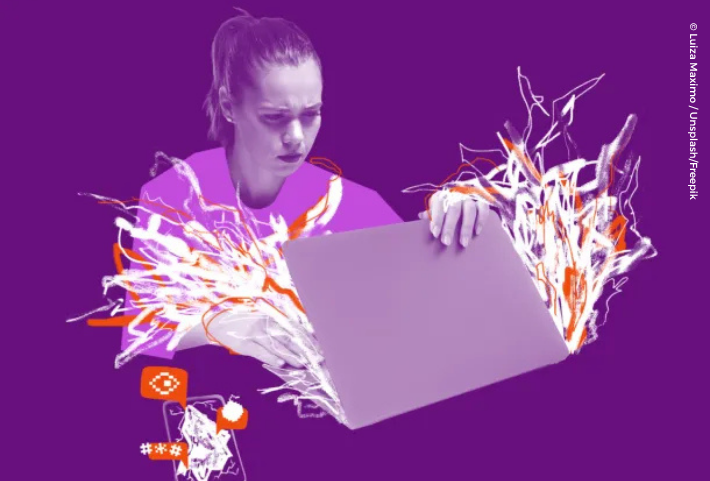
In the UK, violence against women and girls (VAWG) was declared a national emergency in July 2024, with an estimated 2.2 million females (9.1%) experiencing domestic abuse. Globally, 1 in 3 women experience intimate partner violence – physical or sexual.
Online violence a ‘structural threat to inclusion’
At a recent Media Diversity Institute Masterclass at the Gabo Festival in Bogota, Colombia, journalists, activists and media professionals from across the region highlighted the need to tackle online violence against women, members of vulnerable groups, and journalists from historically marginalised groups.
They called for recognition that online violence is a structural threat to media diversity and inclusion, as it generates self-censorship and discourages the participation of journalists from marginalised communities. They recommended that tackling digital violence should be understood not only as a freedom of expression issue but also as a necessary condition for protecting media diversity.
AI is making online abuse easier
The UN is warning that Artificial Intelligence is reproducing old gender stereotypes and making some forms of violence easier to create and spread. There are concerns that as AI-generated content becomes the norm, harassment, manipulation, and image-based abuse will become harder to detect and prevent.
In the UK, almost three-quarters of the public want the government to do more to tackle online VAWG, including regulations on AI. More than 60 per cent of those aged 18 to 24 think the internet has become more dangerous for women and girls in the past 12 months.
Activists and civil society groups are unhappy with the pace of change. In May, when the King outlined the legislative agenda for the coming UK Parliamentary session, End Violence Against Women highlighted that VAWG and AI regulations were missing from the government’s plans.
Janaya Walker, Interim Director of the End Violence Against Women Coalition, said in a statement: “Whilst there are some flashes of good to come in forthcoming legislation, VAWG was largely absent from this King’s Speech, along with desperately needed regulation on AI. Instead, the Regulation for Growth Bill and Immigration and Asylum Bill signal a government with ill-judged priorities. Women and girls will bear the cost of both tech companies’ profit-making and the erosion of human rights for an anti-migrant agenda. We urge the government to redirect towards a more rights-respecting agenda, with the prevention of VAWG at its centre.”
Proposed action plans
In June, the Council of Europe launched a new recommendation aimed at strengthening accountability for technology-facilitated violence against women and girls, which includes cyberstalking, online harassment, the non-consensual sharing of intimate images, privacy violations, misogynistic hate campaigns, threats and image manipulation.
As the Council of Europe stated, such abuse often accompanies other forms of violence, including domestic violence, allowing perpetrators to extend surveillance, coercion and control through digital tools.
The new Recommendation provides guidance for Member States on enhancing their legal, institutional and regulatory responses to technology-facilitated VAWG, and proposes a comprehensive notion of accountability, extending beyond criminal law to civil and administrative fields.
At a recent Global Partnerships Conference, co-hosted by the UK Government, delegates from around the world focused on the issues of VAWG, calling for prevention to be embedded in core development work across different sectors.
Robin Mearns, World Bank Group Director for Gender, said that VAWG isn’t inevitable and prevention should not be treated as a ‘side issue’.
“Something not commonly mentioned is financial abuse, which intersects with other forms of intimate partner violence,” said Mearns. “Keeping girls in secondary school can avoid this.”
Other preventive efforts discussed included safer transport and urban designs to help reduce sexual abuse.
Seyi Akiwowo, an adviser on digital governance, told the Global Partnerships Conference that workshops that counter disinformation are needed to increase safety for women. Recalling her time at Glitch, a charity with a mission to ensure that internet technologies do not replicate or further discrimination to Black women and other marginalised people, she said: “Just after one hour of our play-based, curious, non-shaming, non-hierarchical approaches around how to be safe online, 97 per cent of people leave more confident in navigating the online space, in spotting misinformation, in understanding the algorithms.”
The role of the media
As MDI’s Executive Director, Milica Pesic points out, the media has an important role and responsibility in reporting VAWG and online abuse.
“Ethical media reporting is crucial in shaping the public’s understanding of violence against women and girls. Everything matters here, from the language used to challenging societal norms to focusing on an offender instead of questioning the survivor. Exposing social media and platforms’ bad behaviour matters too. “What begins online doesn’t stay online”
However, media coverage of VAWG is in decline, despite high levels of sexual misconduct and violence against women and girls, and a series of high-profile cases involving abusers.
The Global Misogyny News Coverage Tracker report: ‘The Missing Misogyny-related Coverage in an Era of Endemic Violence against Women’, released in April, found that misogyny-related coverage remained marginal between 2017 and 2025, averaging just 1.6 per cent of total online news output. It plummeted to a decade low of 1.3 per cent in 2025.
While coverage of VAWG is down, the report highlighted where media attention is growing. Between 2020 and 2025, references to gender ideology, a term used by the global anti-gender equality movement, have increased in news coverage by a factor of 42. Other findings include men’s perspectives leading coverage and growing, with 1.5 men quoted for every one woman in misogyny-related stories, and among the top 50 English-speaking global news providers, just five news or aggregator websites account for over half of the article titles focusing on women’s misogyny-related disadvantages in society.
As the report points out, action is needed to tackle the news media’s blind spot when it comes to coverage of misogyny-related harassment and violence against women and girls.