By Marwah Alamin
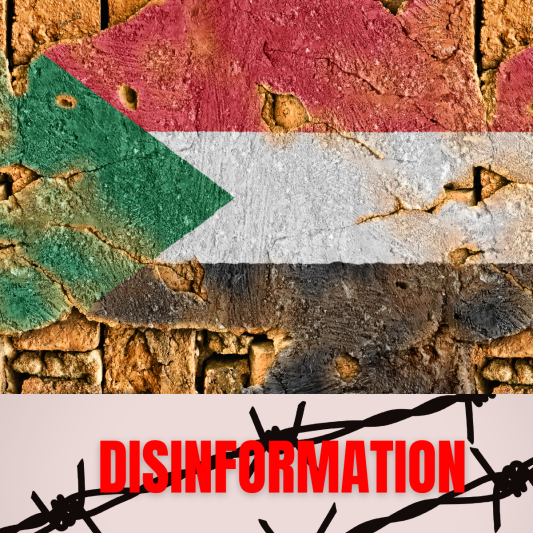
On 15th April 2023 fierce battles broke out in Sudan not only on the ground but also in image and narrative. Media drowned in political military propaganda, hate speech, and fake and misleading content between groups aligned to both the Sudanese Armed Forces (SAF) and Rapid Support Forces (RSF), according to observers.
The war’s virtual battlefields were much larger than the ones on the ground. Information shows that both SAF and RSF used their influence on various outlets to promote their narratives, political stance, and sometimes cover their defeats. Fake news and propaganda spread wider than gunshots while Sudanese people were largely counting on social media for updates from the ground.
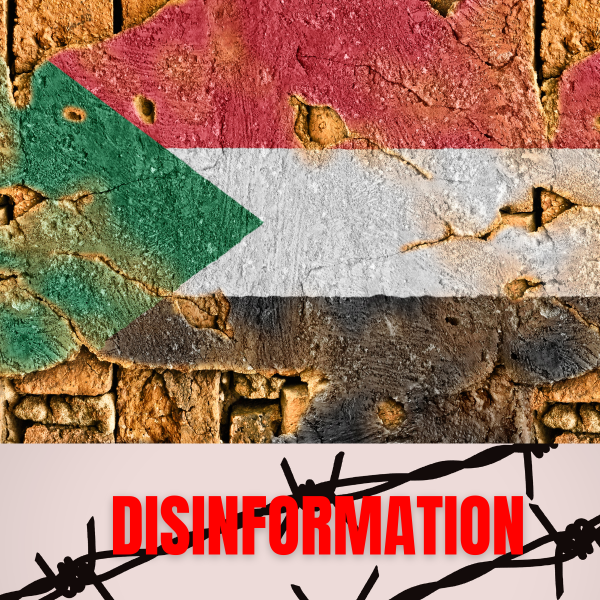
As the war approaches its 3rd year, the misleading content about battles as well as propaganda are still spreading. Actors are utilising various factors such as controlling some news coverage, using social media, and restricting the freedom of journalists and media outlets, which is impacting the country’s social fabric by weaponising ethnic affiliation, and dehumanising ‘others’.
Impact on social cohesion
Hate speech has been a major form of mis/malinformation in Sudan’s media sphere since the conflict started. It is mainly used to dehumanise ethnic groups and justify atrocities committed against them. While hate speech is a deep-rooted issue in Sudan and was used to fuel previous conflicts in different regions, it has played a larger role in the ongoing war causing massacres, unfair arrests, and trials relying only on ethnic affiliation in both SAF and RSF controlled areas.
Information officer at the Sudanese Centre for Media and Information Literacy (SCMIL), Ali Mohammed Noor, believes that hate speech was used heavily to fuel fighting and violence.
“An old and innovative pattern of ethnic and class-based hate speech was fuelling the conflict and giving legitimacy to crimes committed by both fighting parties,” Noor said.
He told MDI that hate speech had a massive effect on social relationships in neighbourhoods, markets, and all forms of daily interactions between citizens.
“These speeches which took over social media were used largely for revenge and settling personal scores through accusing innocent individuals of espionage with either SAF and RSF to get them arrested or even killed,” Noor said.
Organised networks promoting hate speech
Numerous in-depth and observatory reports such as Beam’s have exposed several complex organised networks on social media platforms promoting fake news and propaganda for both SAF and RSF from countries such as Egypt, Ethiopia, Russia, and the UAE.
Most recently, an organised network from local news sites and certain public figures related to the Omar al-Bashir regime that had aligned with SAF activities in spreading disinformation on social media platforms was exposed. This pattern isn’t new; these organised groups have been operating since al-Bashir’s regime. It was accused of using Russian public relations companies in order to improve its image and cover up its crimes.
Some TV channels are also seen to back one side or position in the conflict.
“Taiba”, a channel owned by Abdulahi Youssif, a Sudanese Islamic movement leader operating from Turkey, was seen as pro-war and anti-RSF. Other media channels and social media organised groups operating from outside Sudan support and advertise false images and narratives about or from the RSF, especially after Meta closed official RSF accounts.
Active social media organised groups, featuring public figures supporting SAF or RSF, spread hate speech and calls for separation with no censorship or warning, which clarifies the nature of the linkage between these groups and fighting parties. These speeches have led to large groups of Sudanese people thinking of separation as relief from the war’s suffering.
Restrictions imposed on journalism
Both RSF and Sudan’s de facto government have forced restrictions on journalists and all types of media outlets whether they were operating or covering atrocities in Sudan. This approach has played a huge role in the spread of fake news, hate speech and disinformation about Sudan and more importantly serving and spreading war political propaganda. News sites, including the one belonging to the Sudanese journalists syndicate, are either facing digital sabotage attacks or are blocked and restricted inside Sudan.
Murtada Ahmed, CEO of Droub electronic journal which had its access restricted recently, believes that “Droub” was blocked for covering the atrocities committed by both RSF and SAF.
“SAF’s previous spokesperson Nabeel Abdalla accused us of being unprofessional and unpatriotic for covering atrocities committed by SAF in different states,” Murtada said. “We didn’t get any official notice before the blocking of our journal site, but we believe it’s a ministry order relying on the previous statements of the minister,” he added.
Minister of information, Khaild Al-Ayser has said that media outlets and journalists who won’t adhere to supporting the “dignity war” will be banned. The latest amendment to the information and cybercrimes law, which calls for tougher penalties of up to 10 years as well as large fines, has raised several concerns among journalists and activists. The amendment uses broad terms in defining cybercrimes like “state prestige, protecting national security, threatening social peace”. It also grants broader powers to law enforcement agencies, allowing electronic searches, seizure of devices and digital content, while giving prosecutors discretionary powers in pursuing cybercrimes even without urgent judicial authorisation.
Journalists in danger
Sudan is one of the most dangerous places for media workers.
The Committee for Justice (CFJ) and Sudanese Journalists Union documented the killing of 14 journalists and media professionals in 2025, with six cases of enforced disappearance, four long-term detentions, nine cases of arbitrary arrest and temporary detention, and four judicial prosecutions. The ICJ says the violations reflect a systematic pattern of targeting journalism and persistent attempts to silence independent voices.
The International Federation of Journalists and Sudanese Journalists’ Union condemned the systematic targeting of journalists by the RSF. In November, the organisations said at least six journalists and media workers had been killed in the country, with the RSF involved in all those killings.
As the RSF doesn’t control internet networks, they can’t block sites, yet they are targeting journalists by killing and arresting them and also forcing media blackouts in areas they control. They only allow their own media channel, aligned media outlets, and organised networks to cover and spread stories from their areas of control.
Secretary of the journalists syndicate Mohamed Abdulaziz says that part of managing war is managing information. “War forced independent media outlets to close, and that void led to the manipulation of information affecting local communities the most.”
Abdulaziz told MDI: “The freedom of the press and the right to access information were highly affected by war. 33 journalists were killed and hundreds were subjected to abuses and arbitrary trials.
“The amendment of the information and cybercrime law didn’t have enough consultations and wasn’t open to journalists and media outlets to give their thoughts or to reflect their concerns,” Abdulaziz added.
Impact on minorities
A 2025 Internews report on the Sudanese media ecosystem outlines the impact the current warring and polarised information environment is having on minorities in the country. It said: “There are stark disparities in information access, with marginalised groups—women, displaced persons, people with disabilities, and rural populations—systematically excluded from vital information.”
It said people either had poor or little internet connectivity or face media controlled by the warring factions. “This digital divide has created information bubbles that reinforce geographic and social fragmentation.”
The outlook
All these factors and players – most of them are not mentioned in the article – shape the information sphere in Sudan turning it into a swamp of hatred and propaganda, excluding and weaponising ethnic affiliation alongside the mass deployment of weapons on the ground.
With no signs of this war ending soon, the fear of Sudan’s social fabric rupturing is increasing, which will only lead to a prolonged war and more suffering.
The views and opinions expressed in this article are solely those of the author and do not reflect the official policy or position of the Media Diversity Institute. Any questions or comments should be addressed to the editor at [email protected] of the Media Diversity Institute (MDI).