By Angelo Boccato
Recent protests across several European countries have captured headlines across the globe, but how inclusive has the media been and whose narratives have they focused on?
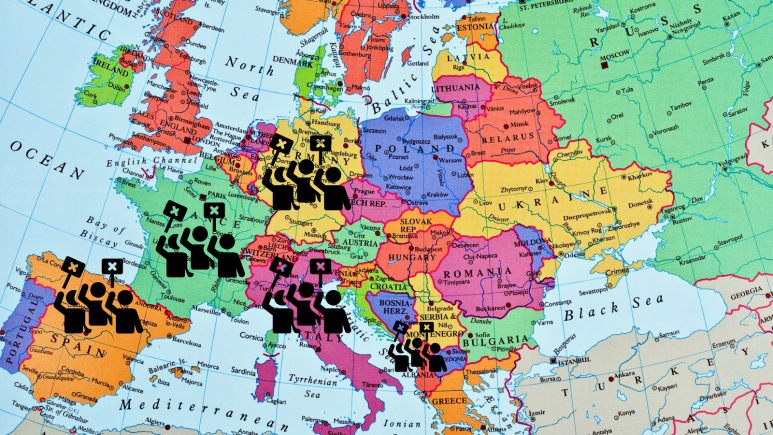
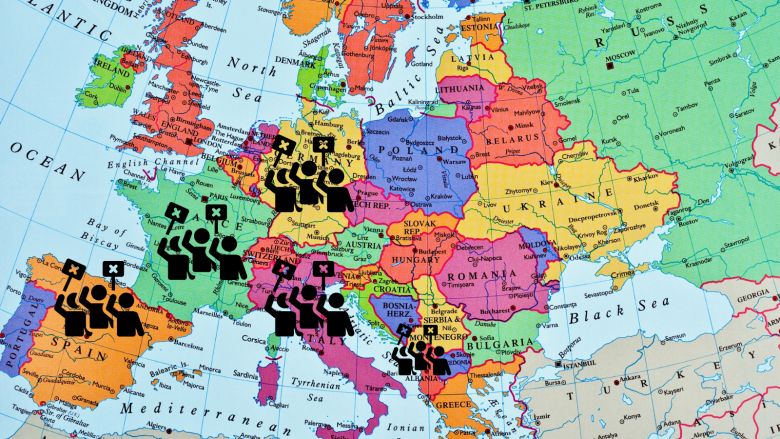
Several European countries have witnessed protests in these last weeks and months, from the student-led ones in France to the Flamingo Revolution in Albania, the protests for social housing in Spain, and the most recent demonstrations against the cost-of-living crisis in Italy. They have more recently been joined by protests across Germany against the high cost of living, underfunding in schools and public spending cuts.
In Serbia, the student movement, which has spent years protesting the rule of President Aleksandar Vučić, managed to defeat him in the October elections, ending his 14 years in power.
While the factors leading the movements differ from country to country, it is difficult not to detect a common dissatisfaction with some of the leaders of these countries, such as Albania’s Prime Minister Edi Rama and Italy’s Prime Minister Giorgia Meloni.
What was the media narrative when it comes to these different movements?
The student movement in France
French students have taken to the streets across the country to protest education cuts and the decaying state of public schools.
Such protests cannot be analysed outside of the frame of a wide dissatisfaction with President Emmanuel Macron’s policies, with Jean Luc-Melenchon’s left-wing La France Insoumise posed as the main opponent to Marine Le Pen’s right-wing Rassemblement National, which has never been so close to power.
With a polarised media in France, the difference in coverage of the protests and political impact by right and left leaning media has been noticeable. It has been influenced by media owners, ideology, and in some cases prejudice.
The essayist Étienne-Alexandre Beauregard labeled the protests as violent and caused by “the overproduction of graduates who will struggle to find job opportunities” in the Journal du Dimanche. The weekly Journal Du Dimanche (JDD) was known for a centrist and mainstream political orientation but this changed after 2023 when it was acquired by the French media mogul Vincent Bolloré whose overwhelming influence over French media has grown over the years; the JDD’s political outlook has moved towards national conservatism and the far-right.
In the context of the protests, the Mayor of Saint-Denis, Bally Bagayoko, a member of La France Insoumise has become popular in the media for standing in front of the students facing French police. Bagayoko, interviewed on Radio France Inter, called out “…the lack of a swift political response,” that “led to an intensification of the protests and, unfortunately, to these tragedies.”
Sixtine Dupont echoed, in the far-right media Valeurs Actuelles, the criticism of Bagayoko and more generally of La France Insoumise, as other prominent members, like Manon Aubry and leader and presidential candidate Jean-Luc Melenchon took to the streets alongside the students.
Researcher Lina Ouanjdeli, instead, focused on Donald Trump’s claims that Islam was to blame for the protests in France in The New Arab. Ouanjdeli included the reaction of the students to Trump’s claim on social media that “This isn’t about schools, this is about Islam wanting to take over a once great Country!” She wrote: “The students reject that. The protests have nothing to do with religion or immigration, they said. High school students come from every background, and there should be no shortcuts. None of them wanted their origins or religion mentioned. They wanted, they said, to be judged on what they were saying.”
Ouanjdeli’s piece included student views. In one, a 23-year-old Arab medical student of North African heritage said he was worried that young people from immigrant families “have their grievances read through assumptions about their identity, rather than their experience”. He told Ouanjdeli that many young people refuse to speak to channels such as CNews and BFMTV, which they see as portraying people from immigrant backgrounds in racist and Islamophobic terms.
Other media has also been more inclusive. Coverage from media like Bondy Blog has provided audiences with different perspectives. It was born out of the banlieues, bringing diverse voices and viewpoints to issues and events.
Sofiane Zerouala wrote in Le Bondy Blog “One week after October 17, the movement has therefore lost none of its ability to mobilize. Restrictions, changes to protest routes, and heightened security measures have not been enough to deter demonstrators. But beyond the turnout figures, the numbers of arrests and injuries serve as a reminder of another reality: the mobilization remains strong, and the repression continues.”
Journalist Francesca Barca, writing in the pan-European media VoxEurop, included the views of student protestors. “Among the demands of this movement are guarantees that absent teachers will be replaced, clean classrooms equipped with the necessary furniture and materials (particularly desks and chairs), decent teaching conditions, less overcrowding in classrooms, and lighter timetables.”
The student movement in France is usually either analysed or demonised, and the electoral race as well as the rising and troubling influence of Bollore are key factors on this front.
Italy and the demonisation of Italians of North African descent
Italy has also witnessed protests against the cost of living recently, particularly in Milan, Turin and Bologna on the weekend of October 17 and 18, and then again on the following weekend.
The incidents that occurred in Milan, which included looting, led to a widespread debate in the country on the supposed culprits, labeled as Maranza. It is a slang term which has been used in recent years as a slur against young people of North African descent in the country by right-wing newspapers like Il Giornale.
Alessandro Rico wrote in fellow right-wing newspaper La Verità that the economic reasons behind the protests are an excuse and that the Italian youth of North African descent are not in fact discriminated against by the West, but give contempt in return for the attention that they received.
In this context, the arrest of 30-year old researcher and activist of Moroccan descent Youssef Siher as the alleged “mastermind” of the October 17 Movement on October 24 seemed to fit the profile presented by Meloni’s far-right government and its supporting right-wing media; a researcher with an excellent resume and not someone in need, but simply someone with an alleged contempt for the West and Italy.
In reality, young, educated Italians compose the bulk of the hundreds of thousands of people who have left the country over the last fifteen years looking for better opportunities abroad, while those who remained face precarious work conditions, especially in fields such as research.
Siher was paraded for days across Italian media derogatively until his release from Milan’s S.Vittore prison, following a decision of the Gip (Judge for the preliminary investigations in Italian). The decision was condemned by Giorgia Meloni herself, highlighting a troubling view of the democratic separation of powers.
Lack of diversity in Italian reporting
“Going back to the demonstration of October 17, the media coverage has been disastrous, alongside the lack of coverage of the protests in the South (where farmers and truck drivers have been protesting against the impact of the cost of fuel). It demonstrates not only a lack of diversity in the newsrooms, especially for the use of the word Maranza, but goes beyond that. This has to do in my view with a lack of objectivity and of journalistic methodology,” Leila Belhadj Mohamed, Italian journalist and podcaster of Tunisian descent, tells MDI.
“On one side, we have RAI, the public broadcaster that acts as TeleMeloni (politicians always exercise a strong control on RAI, but the level of control exercised by Meloni was probably not seen since the time of Silvio Berlusconi’s governments), Mediaset belongs to the Berlusconi family, the main shareholder of Forza Italia (the party founded by Berlusconi in 1994 and part of the government coalition), but also LA7, Sky and all the press have shown a myopia in telling the social causes that led these young people to the streets”.
Mohamed further adds that the acts of brutality from the police have not been told by the media. Just like in France, the issue of media ownership is a crucial one in terms of what the media report.
Spain and the housing crisis
Social housing has taken a central stage in Spain, following the eviction of 87-year old María del Carmen Abascal in Madrid in September.
It was the catalyst of an ongoing mobilisation that has also influenced the political agenda in the country and will be central in the elections of November 29.
The high costs of rents and prices were discussed in the podcast Carne Cruda in a critical way, related to the dramatic increase in cities like Madrid and Malaga alongside others. The podcast also interviewed those protesters who were camped at Puerta del Sol, in Madrid.
Clara Rojas and Daniela Saltos wrote in El Mundo of how the housing crisis is leading the Spanish youth to rent in places without common areas.
In terms of political leaning, right-wing media are not denying the reality of the housing crisis but tend to focus more, like in the case of La Razon, on migration, especially when it comes to the fallout after Ceuta.
In El Confidencial, another centre-right leaning media, Ernesto Torrico, Giulio Maria Piantadosi and Alejandro Requeijo analysed the differences between Ceuta and the Italian island of Lampedusa, pointing out that despite the similarities, the migration ‘crisis’ was larger than the ones witnessed in Lampedusa and it is not yet clear how many of the 70,000 to 80,000 Moroccans arrived between the 30th and 31st of July have remained in the exclave.
In the same media, Ruth Ugalde wrote about the two sides of migration; immigration pushes up the cost of housing on one hand but on the other, without it there would be no more supply.
Inclusion of youth in coverage
While youth stand at the centre of the European protest movements, their inclusion in the debate has not been homogenous in the continent’s media.
In a polarised media environment, political outlooks and media ownership play a central role in the degree of inclusion of young voices in the collective narrative and in the different tones – shifting from paternalistic condemnation to an actual analysis of the roots of dissent. In an information ecosystem which excludes them, young Europeans are turning more and more to social media to make their voices heard, without intermediaries.
The views and opinions expressed in this article are solely those of the author and do not reflect the official policy or position of the Media Diversity Institute. Any question or comment should be addressed to [email protected]