By Tanya Sakzewski
The Indo-Caribbean community is often neglected in UK media coverage, which risks reinforcing a narrow understanding of the Windrush generation and migrants’ contributions to British Society.
That is one of the key findings of research by Dr Aurora Herrera from London Metropolitan University.
Her research, “Investigating the lack of Indo-Caribbean representation in the Windrush media narrative”, aims to uncover why the group is missing from coverage and what impact this has on the community’s sense of belonging. Indo-Caribbean refers to people of Indian ancestry from the Caribbean.
The impact of a community neglected by the media
Dr Herrera’s research sets out to try to answer three main questions:
How Indo-Caribbean people feel about their representation and understanding within British society. Do they feel they are acknowledged as part of the Caribbean community?
What editorial norms are within newsrooms? How do journalists and editors make decisions about covering the Caribbean community—for example, who they profile and who they treat as experts?
How inclusive is imagery? Who is represented in still and moving images of Windrush commemorations?
Dr Herrera has interviewed more than 30 members of the community and found that the majority do not feel they have an acknowledged place in Caribbean society.
“British society doesn’t understand Caribbean diversity or indentureship,” Dr Herrera told MDI.
She says a key finding of her research is that the lack of coverage has led to a “reduction of Caribbean identity” which has “significant consequences”. The repeated omission of a group from public narratives leads to its gradual erasure from public consciousness.
“We have so many different ethnicities in the Caribbean, especially in Guyana, Barbados, Trinidad, and St Lucia,” Dr Herrera said. Caribbean communities include Indigenous people, as well as people from European, Indian, Chinese and African heritage.
She added: “The British public doesn’t really understand Caribbean diversity.” She said members of the Indo-Caribbean community are often mistaken as coming from India.
One of her interviewees, the daughter of an Indo-Caribbean Windrush migrant from Guyana, warned of the “damaging” impact that the lack of media representation and knowledge about the diversity of Caribbean people has caused. “Nobody would ever look at me and imagine that I’m a daughter of the Windrush generation.”
Interviews reveal that this invisibility is felt deeply by people from Indo-Caribbean backgrounds. Because of this lack of acknowledgement, members of the community worry the UK public does not have the full picture of Caribbean migration and identity.
“This omission risks reinforcing a narrow understanding of the Windrush generation, overlooking the ethnic diversity that exists within Caribbean communities and diminishing the contributions of Indo-Caribbean migrants to British society,” Dr Herrera said.
As one interviewee told her, “The word Caribbean has come to mean one thing” in the UK.
By examining how and why these absences occur in media representations, her research seeks to contribute to a more inclusive and historically accurate understanding of the Windrush legacy and Caribbean people.
About the Windrush generation
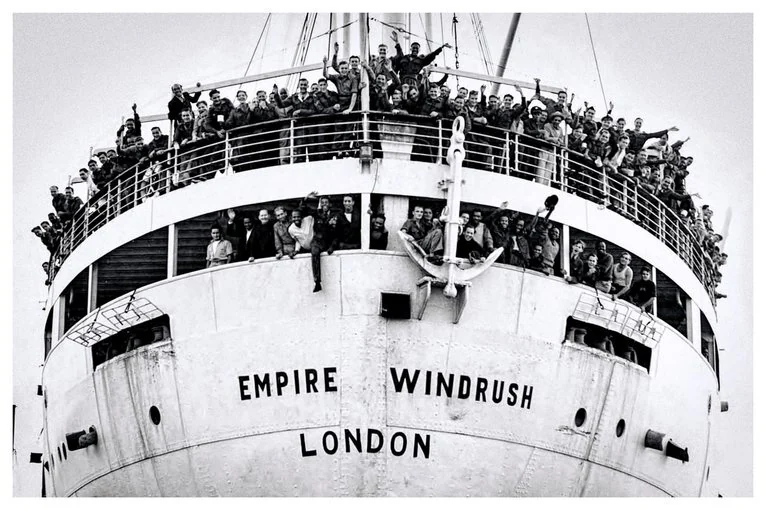
The Windrush generation arrived in the UK between 1948 and 1973 from the Caribbean, which was then part of the British Commonwealth. They filled labour shortages in the post-war era and were automatically British citizens on arrival. The name refers to the HMT Empire Windrush ship, which brought one of the largest groups to the UK.
In 2017, the Windrush generation dominated the news when it was revealed that many of them were part of a group of hundreds of Commonwealth citizens who had been wrongly detained and deported. Journalist Amelia Gentleman wrote about individual cases of Black British Caribbean residents being denied citizenship, being detained, and being threatened with deportation, or deported.
An article for the Media Diversity Institute in June 2023, marking the 75th anniversary of the docking of the HMT Empire Windrush in Essex, examined media coverage of the milestone. Much of that coverage focused on the experiences of Black Caribbeans.
Dr Herrera says the story of Windrush usually focuses on the Afro-Caribbean community, excluding other groups. While there is no exact number of Indo-Caribbean or Chinese-Caribbean people who came to the UK during the period, “we know they came”.
Indo-Caribbean community’s link to British history.
Indo-Caribbean identity has a direct connection to British history. Under British indentureship between 1838 and 1917, approximately half a million Indians were taken to the Caribbean to work on plantations. The Indo-Caribbean community that formed from this migration shares a mixed Indian-Caribbean culture.
Descendants of the indentured labourers were among those who migrated to the UK during the Windrush era.
“The omission of Indo-Caribbean voices from Windrush narratives is also connected to a wider historical erasure of indentureship. Following the abolition of slavery, over half a million Indians were transported to the Caribbean under systems of indentured labour. Yet this history remains poorly understood in Britain,” said Dr Herrera.
It is difficult to estimate how many people of Indo-Caribbean descent are in the UK as there is no distinct category for the group on the census or official documents.
“An inclusive media narrative would not diminish the significance of the Windrush story; instead, it would enhance it by acknowledging the diverse experiences that have contributed to the development of modern Britain,” said Dr Herrera.
Social media reaching the community
Young influencers and events are filling the information gap by raising visibility of the Indo-Caribbean community.
Dr Herrera has interviewed culture makers as part of her research and found that “through events and exhibitions, the communities are staying strong and showing representation through these events”.
Young influencers are using social media to push and represent Indo-Caribbean people in the UK. “It’s really wonderful to see the younger generation is really trying to get more visibility for their community,” said Dr Herrera.
What should the media do?
Dr Herrera says the media needs to be more inclusive but shouldn’t substitute one community with another. It needs to expand the perspective through which Windrush is interpreted.
“Such an approach would facilitate a more comprehensive and historically accurate account of Caribbean experiences in Britain, incorporating Indo-Caribbean, Chinese-Caribbean, and other communities whose histories have frequently been marginalised,” she said.
When asked what they would say to the media, her interviewees said: “Please educate yourselves about the Caribbean community and its diversity, please recruit more diverse voices when you are covering the Caribbean community, more visual representation of different people from different islands, and more representation of languages and cultures.” They also want a wider range of experts in coverage.
Fighting for recognition
According to Dr Herrera, part of the problem is that there has never been an explicit Indo-Caribbean category in official records, including in the modern UK census.
People she interviewed said that, as a result, media narratives “don’t really focus on us”.
Dr Herrera has launched a petition to have ‘Indo-Caribbean’ identified as an ethnic group on Government documents. The petition argues that people of Indian-Caribbean heritage have no place to accurately identify their ethnicity and need better representation in UK equality data. The petition, which is open until 18 March 2027, needs 10,000 signatures to receive a government response and 100,000 to be considered for debate in Parliament.
“Almost everyone I interviewed brought up the government box, where they have no place, they have no existence, and they said they usually tick ‘other’ and write Indo-Caribbean as an ethnicity,” she told MDI.
“The feeling is very strong in the community; they are part of the Caribbean community, but they are not identified or given any sort of basis for identification by the government.”