By Tanya Sakzewski
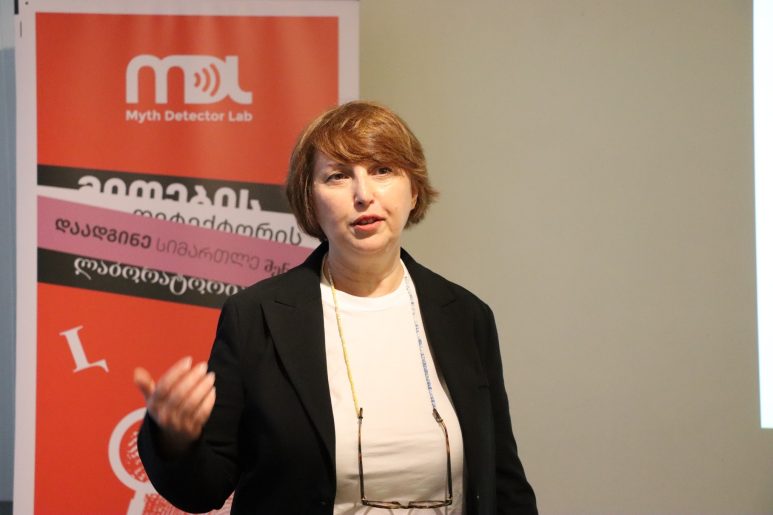
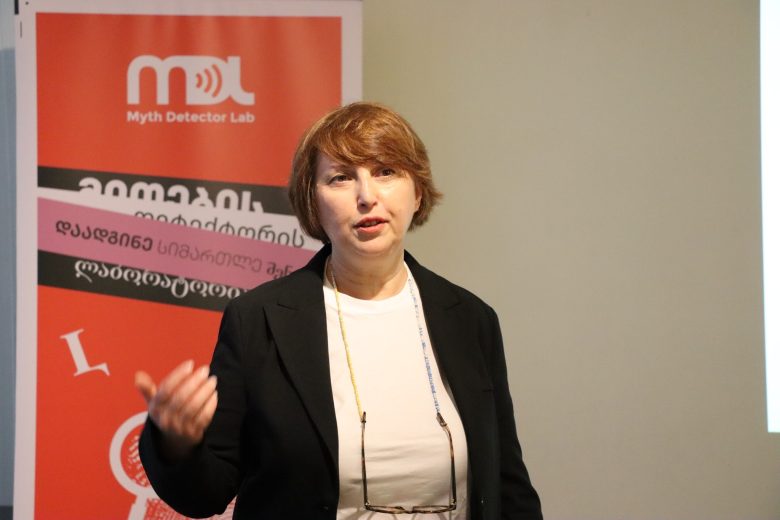
Georgian Journalist Tamar Kintsurashvili was recently awarded the 11th Deutsche Welle (DW) Freedom of Speech Award at the Global Media Forum for her commitment to fighting disinformation and promoting media literacy in her country.
That fight has become more challenging in the past year. Like many NGOs, Kintsurashvili’s organisation, the Media Development Foundation, is facing an uncertain future.
As well as navigating new laws that are impacting both funding and operations, they have been subjected to threats and harassment. Last year, the Georgian government introduced a foreign agents’ law, which requires organisations with 20 per cent of their funding coming from abroad to register as “agents of foreign influence”.
MDI caught up with Kintsurashvili, Executive Director of the Media Development Foundation and Editor-in-Chief of the Myth Detector, to find out how her organisation operates under tighter restrictions and how those restrictions affect diversity in the media.
How do you hope the DW Freedom of Speech Award will help you and other organisations in Georgia?
First of all, this is recognition of the importance of the work we are doing in Georgia and in the wider region, because we’re dealing not only with domestic homegrown disinformation campaigns, but Russian information influence operations in Georgia, Ukraine, Belarus, and Russia. It serves as motivation for our staff to keep up the fight, which is difficult given the new legal landscape and the extremely hostile circumstances facing all democratic, pro-democratic actors and institutions in Georgia.
In light of this Foreign Agents Law, we experience a lot of orchestrated campaigns and vandalism against our office. Right now, we are under investigation by the Anti-Corruption Bureau, based on a Facebook post depicting a joint statement of NGOs on the foreign agents law and violence against journalists, which also highlights the importance of preserving democratic institutions in the country. We are facing a threat of shifting from the European path to authoritarianism. So, this award is a reminder that we should continue this fight in this new environment, which is more difficult than it was when Georgia became an EU candidate country back in December 2023.
Have you had any feedback from other Georgia organisations about this award?
This is perceived as international support for local watchdog organisations and acknowledging our fight against hostile actors and anti-democratic movements. And as I mentioned in my (acceptance) speech, this award is an honour for every freedom fighter in Georgia who tried to preserve Georgia’s achievements.
Could you describe what your organisation is doing, its impact, and what difference you’re making, particularly now?
The goal of our organisation is to protect information integrity, which is a cornerstone of democracy, since in democracies people make decisions based on informed choices. That’s why autocratic countries try to control information, and they are using different platforms and methods to manipulate public opinion. Georgia, as a country partly occupied by Russia, faces a double problem – the so-called FIMI, Foreign Information Manipulation and Interference, and domestic homegrown propaganda and disinformation campaigns.
Our operations are not limited only to fact-checking. Besides fact-checking, there are harmful narratives that create a toxic context, and the attempt is to create conflicts between people based on their ethnicity, religious beliefs or gender identity. This is mostly the Russian playbook, which was, by the way, adopted by our own government, because it’s very easy to manipulate public opinion by using very sensitive topics related to our identity.
In addition to fact-checking and discourse analysis, we do investigations on coordinated inauthentic behaviour (CIB) when trolls and fake accounts, mostly affiliated with the government, are trying to manipulate public opinion and discredit opponents, and they are abusing the administrative resources for these purposes, because we revealed a number of cases when these accounts were linked to different ministries, strategic communication units, or local municipalities.
In addition, we work on resilience building of society, through media literacy programmes, and our goal is to engage citizens in fact-checking. It’s impossible to address all this misinformation on the platforms. It’s better to have open-minded people equipped with the tools so they are able to differentiate the fabricated content from the real one. And at the same time, to preserve trust in mainstream media, because this is also a challenge for democracy, is how people are consuming the news and trusting the media. In this information disorder where everybody lies, this perception affects democracy and trust in democratic institutions as well.
Are these efforts to manipulate public opinion working?
Yes, unfortunately, it is working in Georgia. Since Russia’s full-scale invasion of Ukraine, our government has changed its public rhetoric on foreign policy. For a long time,they were playing a double game , delivering different messages abroad and different ones internally. The renewed war in Ukraine was a turning point. Since then, the government’s rhetoric has become more openly anti-Western. Compared with fringe and fragmented pro-Kremlin channels, the government has more resources to manipulate public opinion: firstly, the government creates the agenda and secondly, they control the most popular TV channels and administrative resources to influence public opinion in a negative way. But they do it in a misleading way. They are not saying that we are against the EU while they are acting against the EU. In the pre-election campaign in 2024, they were using EU symbols to say that we’re moving to the EU, but with dignity. Under dignity, they mean sovereign democracy. This concept was developed by the Kremlin, speculating that if you are questioning our democracy, you are interfering in domestic issues. They are using the same Russian playbook. Because they have the concentration of the big TV channels in their hands, it’s much easier to manipulate public opinion. And it’s easy to sell rather than openly pro-Kremlin media outlets, who are lacking the trust per se.
How has the new environment affected diversity in the media?
The Georgian media market has never been self-sufficient, and competing political interests have always driven pluralism, especially in broadcast media. On the other hand, Western donors have been the primary supporters of public interest media, community radio, and inclusive media reporting. In addition to the foreign agent law, the government introduced amendments to broadcasting legislation that ban foreign funding for audiovisual broadcasters, and as a result, regional broadcasters may face existential threats, along with online media outlets that rely heavily on Western funding.
Georgia, being a multi-ethnic and multi-religious country, encounters language barriers that affect access to news programs in minority languages. Funding from Western donors has been crucial for content production, enabling minorities to receive information in their local languages and supporting community radio. Such inclusive reporting is frequently neglected by commercial channels and is only formally addressed by the public broadcaster.
You’ve moved your conference to Moldova. How else have the new laws impacted the way you operate?
Last year it was easier to plan future steps, even under one repressive legislation. Right now, it’s much more difficult, because in response to the claim that this is a Russian law, Russian-style law, the government literally translated US FARA (Foreign Agents Registration Act), saying, though, we don’t like this law, but this is American; let’s try to improve it. American FARA is tailored for lobbying activities, not against domestic institutions, because when we receive funding for media literacy, textbook production, it’s not for Germany, or Netherlands, or the UK who provide funding, but for Georgian citizens to be more resilience and this is the difference between lobbying activities and between activities supporting democracy in our country. Under the new FARA, not only organisations but also individuals receiving funding from foreign organisations should register as foreign spies. And it had a chilling effect on staff.
You and your colleagues have been threatened and your office vandalised. Can you explain the kind of pressure you’ve been under?
Actually, the first wave of intimidation started during the adoption process of this law, with calls to us, to my family members. Then, before the election, up to the election, we received emails with rape threats. They were targeting me and fact-checkers specifically, and we filed complaints, and there was no investigation, even formally.
Are you confident you can keep operating in some way?
We want to try all means to continue this operation in Georgia. It’s not only the survival of one NGO, it’s the survival of independent watchdogs in this country because our case will have chilling effects on other organisations, especially regional ones, and we have no time to abandon what we have been doing for a long time in this country. Of course, many partners are offering relocation and other things. Still, I think this is a moment when we should stay here in the country and continue our fight for a European, democratic Georgia.