How the media represents young queer people in Serbia was discussed at an event as part of Pride Week in Belgrade.
The event, “Student Protests Aren’t Black and White, Because We Are There” organised by Media Diversity Institute Western Balkans and the Talas TIRV Collective, brought together 15 participants to discuss resilience and resistance, diversity, and collective activism through a creative critique of media representation of the queer community, especially young people actively fighting for change.
The event explored how queer people are often portrayed in the media as a “problem” or “provocation,” or are not represented at all.
Discussions covered media reporting during protests, hate speech, and police brutality, which does not distinguish between queer and straight demonstrators, and how media coverage often erases or distorts reality.
Participants also reflected on how it feels to fight for a democratic Serbia while facing insults and hostility directed at the queer community.
Human Rights Watch highlighted in its World Report 2025 that LGBT people in Serbia continue to face intolerance, threats and violence.
The EU LGBTIQ survey III LGBTIQ Equality at a Crossroads: Progress and Challenges released in 2024 found that Serbia still has room for improvement in creating an environment where the community feels safe and respected.
- More than 80% in Serbia often or always avoid holding hands with their same-sex partner. That compares to 53% in the EU-27.
- More than 43% in Serbia often or always avoid certain locations for fear of being assaulted. For the EU-27 it is 29%.
- And less than 29% are fairly or very open about being LGBTIQ in Serbia. For the EU-27 it is 51%.
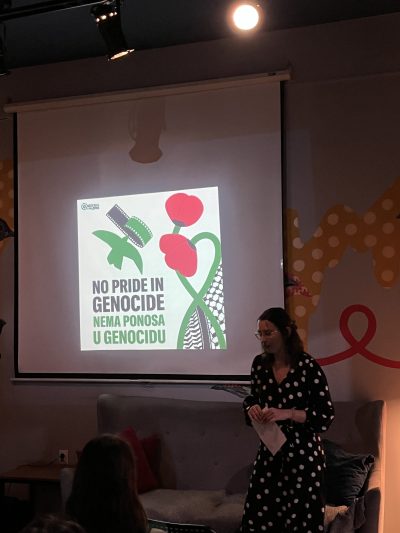
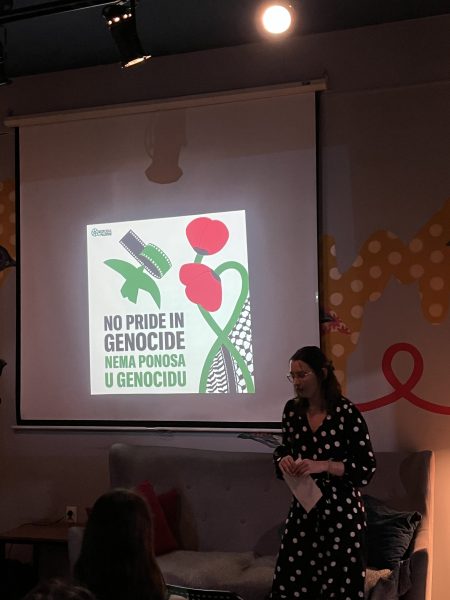
To coincide with Pride Week in Serbia, MDI Western Balkans also organised “No Pride in Genocide” to express solidarity with Palestinians in the struggle against Israel’s occupation, systemic violence, and the ongoing atrocities in Gaza.
The event, involving the screening of short films, attracted a full crowd of around 50 people.
“No Pride in Genocide” is an initiative by Queer Cinema for Palestine, which was created as an alternative space for filmmakers who chose to withdraw or refuse participation in the Israeli government-sponsored TLVFest LGBTQ+ Film Festival. Over the past six years, hundreds of filmmakers have shown solidarity with queer and trans Palestinians through this initiative, which challenges the use of queer and trans identities to justify oppression and emphasises the role of art as a form of resistance and liberation.
The Belgrade programme featured works by queer, Palestinian, and allied artists from Canada, Germany and Lebanon, showcasing diverse perspectives, genres, and formats, including documentary, experimental, fiction, and animation.
“All struggles are interconnected. The fight against occupation, homophobia, transphobia, racism, misogyny, and capitalist exploitation is part of the same shared struggle for freedom and dignity,” said Ivana Jovanović, Program Manager at Media Diversity Institute Western Balkans, during the opening of the event.
The screening concluded with a discussion among participants, accompanied by Palestinian cuisine, fostering a space for reflection, dialogue, and community building.