By Angelo Boccato
The arrival of 70,000 to 80,000 migrants from Morocco, between the 30th and 31st of July in Ceuta, led to an unprecedented migration crisis, orienting the debate playing out in the media in Spain and across Europe.
Giorgia Meloni’s government responded by suspending the Schengen Agreement with Spain in a clearly propagandistic manoeuvre, given the geographic context (the agreement was only reinstated on October 22), while in Spain, the right-wing Partido Popular and the far-right party Vox attacked Prime Minister Pedro Sánchez for his stance on migration and the government’s supposed inability to defend Spain’s borders.
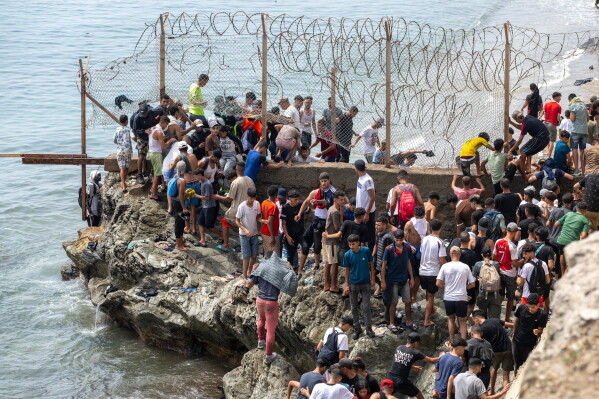
Even though most of those who reached Ceuta returned to Morocco, the events there are still leading the political conversation in Spain and have been a key factor in Sánchez’s decision to call a snap election on November 29, specifically to avoid the Partido Popular and Vox leading the political conversation on migration until the expected time of the elections in 2027 (and instead moving it on social topics such as housing).
How is the situation in Ceuta influencing the debate on migration in Spain and across Europe, especially as Italy, France and Germany head to the polls in 2027? With the far right in Italy seeking a second term and far-right parties in Germany and France moving closer to power, migration is once again a key issue.
An engineered migration crisis?
Social media rumours are thought to have prompted the migrants to enter the Spanish enclave. Misleading information suggested that migrants arriving by sea would be allowed to stay in Spain.
Spanish fact-checking organisation Maldita.es analysed more than 1,100 Arabic-language Facebook posts between 8 and 31 July. They found that one disinformation message spread more than 215 times on the day the migrants crossed to Ceuta. The message claimed a Spanish Supreme Court ruling meant migrants who reach Ceuta and Melilla by swimming would not be immediately expelled.
Several groups and governments have been blamed for the misleading claims and misinformation.
In August, European Commission spokesperson Guillaume Mercier said disinformation about Ceuta could come from “state-controlled media, diplomatic channels, or even sources close to the Kremlin”.
Pedro Sánchez accused networks linked to Russia, Israel and the far-right of running interference and spreading disinformation related to Ceuta, back in September.
While the EEAS (European External Action Service) ruled out conclusive evidence that foreign disinformation caused the migratory crisis in Ceuta, it did detect Russian attempts on the networks.
There was also speculation that Morocco may have engineered the mass crossing – a claim both the Moroccan and Spanish governments denied in August.
However, some media have focused on claims that Moroccan authorities engineered the mass migrant influx to destabilise the Spanish frontier.
Spanish investigative journalist José Bautista told MDI that, according to his sources, Rabat planned and designed what happened in Ceuta.
“There are many rumours: the ruling of the Tribunal Supremo de España, Israel, the United States, but there’s no evidence, only rumours. The information I have found, based on sources from Spanish and Moroccan intelligence, is that Moroccan authorities designed and executed the crisis of Ceuta [this was also reported in a leaked report by Spanish police debunking the government’s view that Rabat had no responsibilities in the events of Ceuta]”
Bautista is part of an investigation involving fourteen media outlets (including Haaretz, The Guardian, El Confidencial, Der Spiegel and others) which revealed secrets of the Moroccan intelligence services, proving that they used the spyware Pegasus (an advanced spyware developed by the Israeli company NSO Group) against Pedro Sánchez and Emmanuel Macron and other European leaders.”
“We also revealed the technological arsenal of Moroccan intelligence used to repress critical voices in the country and the intelligence modus operandi used for such repression in the country, and we published all this using different sources, including former members of Moroccan intelligence. Morocco thought Spain was protecting one of these sources and had put this person in touch with journalists; while that is not true, that’s what Moroccan authorities believed.
“So, Moroccan intelligence decided to express its displeasure with Spanish intelligence. How? By engineering a migrant crisis, and not for the first time. However, they lost control of the situation, as they didn’t expect up to 80,000 people to cross the border in a day and hoped for far fewer. Spanish intelligence also did not know that so many people would cross the border,” continues Bautista.
The Spanish elections
Pedro Sánchez is one of the few left-wing leaders in Europe, and his government stands among the few that have not practised an openly hostile approach to migration, as it approved a decree to regularise 500,000 undocumented migrants back in January this year.
His stance on the genocide in Gaza has also made him an isolated voice in the European context.
“The international far right hates Sánchez just like the national right hates him; the PP and Vox have been profiting from Ceuta’s crisis to attack him, for example, Giorgia Meloni in Italia. Even supposedly social-democratic governments, like Denmark, attacked the PM over the Ceuta crisis,” said Bautista.
He added: “On the other hand, while Sanchez’s government passed a regularisation of migrants for economic reasons, its migration policy did things quite similar to the far-right, for example through borders’ externalisation. While Giorgia Meloni provides Libya with equipment and ships, the Spanish government does the same thing with Morocco.”
Political discourse on migration
“There is a huge difference between the reality of the streets and the political discourse when it comes to migration in Spain,” says Bautista.
A study by the Spanish think tank Funcas found that: “Immigration is playing a key role in the current expansionary cycle of the Spanish economy, to the extent that the incorporation of foreign workers is estimated to account for 47 per cent (4.2 percentage points) of the cumulative GDP growth since 2022.”
However, some politicians and members of the public see migrants very differently, with events in Ceuta leading to an increase in hate speech online.
The Spanish Observatory on Racism and Xenophobia logged 9,590 hate messages in two days coinciding with the influx of migrants. People from North Africa were the main target of the online hate speech, accounting for 68 per cent of the content detected in July. Messages targeting immigrants made up 19 per cent of the total. In general, social media content aimed to discredit migrants, presenting them as threats, and calling for their expulsion from the country.
In this hostile climate, the Spanish branch of Amnesty International and more than 420 organisations and journalistic and cultural personalities have launched a campaign against the surge of racism following the events in Ceuta.
Propaganda and facts often clash over migration in Spain and across Europe. As the Partido Popular and VOX are expected to keep the focus on this front in the upcoming elections, the outcome will be important for evaluating the electoral races of 2027 in Italy and France. In both countries, recent protests are being misrepresented as having to do with Islam and migrants.
The views and opinions expressed in this article are solely those of the author and do not reflect the official policy or position of the Media Diversity Institute. Any question or comment should be addressed to [email protected]