Youth may have led protest movements across the globe, some which have resulted in policy and political change, yet they don’t always find themselves represented in the media or listened to by authorities.
So, what do they need to do to elevate their voices and increase their visibility?
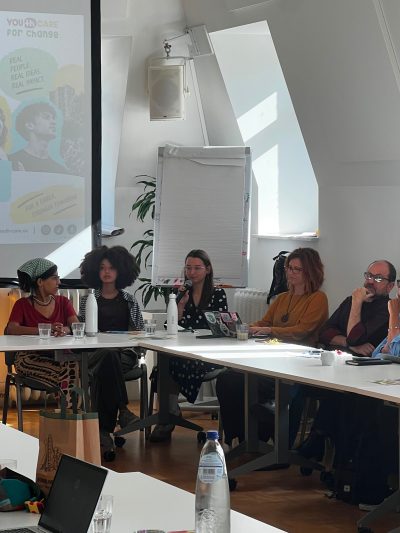
A YOU(th) Care For Change Rethinking Youth Work and Activism Seminar in Brussels last week heard that collaboration and the opening of online and offline spaces are vital for youth to successfully engage in society and contribute to tackling global challenges.
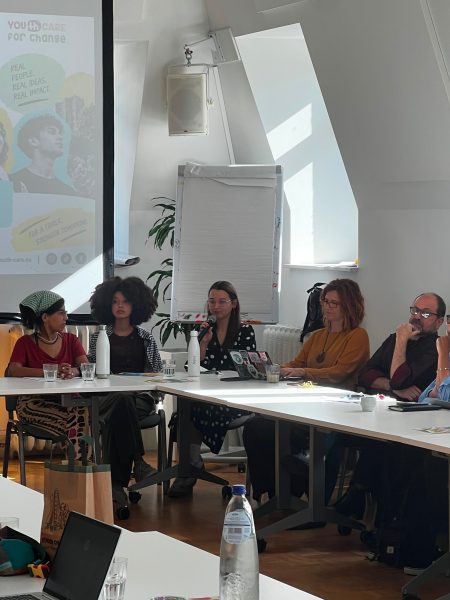
Participants from 12 countries involved in the project, which is in its third and final year, gathered in Brussels from 15-18 September to share their experiences. They discussed the driving forces behind youth activism, the need to rethink youth work through an intersectionality lens, and how to build networks to strengthen their impact.
Engaging with institutions
One session examined the need to open dialogue between youth and European institutions. The main message of the discussion was the importance of building alliances, with youth encouraged to not fear reaching out and claiming the space to set their expectations. But they were reminded of the need to set clear and structured expectations in advance.
Gabriele Sorce from The Good Lobby said it was important to open spaces for youth at the national level and find ways of including their ideas and policies. “We are lacking concrete mechanisms to implement what the youth is saying.”
Mobilising effectively
The YOU(th) Care For Change project has supported hundreds of youth from across Europe and the Mediterranean to identify common advocacy opportunities and partner and collaborate for greater impact.
One of the key messages of the project was “Youth needs Space, Society needs Youth”. Campaigns focused on reclaiming spaces – physical, digital, educational and political – for youth.
Speaking about the changing ways young people organise, Tamara Todorović from the National Youth Council of Serbia said that, particularly in the context of the student mobilisation in Serbia, “young people are increasingly organising outside traditional structures”.
She noted that they are “creating their own networks, communities and temporary spaces around issues they care about”, rather than necessarily seeking membership-based organisations or formal spaces. For Todorović, this means that youth spaces need to evolve with this reality – remaining “open, accessible and flexible” while giving young people the trust, resources and autonomy to shape them themselves.
Participants at the event shared their experiences of working together to amplify messages and ensure youth voices are mobilised and listened to. They say they want to address the issue of ownership of spaces as well as the issue of repression that comes with it.
Denisa Bajraktari, from the Youth Council Albania, said: “We are not waiting to create a space for us, but we are participating in its installation. A city needs spaces where young people can belong.”
Panagiotis Chatzimichail from the Organising Bureau of European School Student Unions (OBESSU) said youth “don’t need help, they need recognition”. “It’s our responsibility to highlight to policymakers that if they don’t allow the space for youth today, they will lose a big opportunity.”
Reclaiming civic & political spaces
Youth across the world – from the Arab world to India and Serbia – have effectively used social media to rally protestors, relay messages and call for political and social change.
While Safae Moud from the Atawish Collectif based in Morocco said social media is an important tool for reaching people outside the community, others reminded of the need for critical analysis in communication and advocacy.
“In order to avoid moralism and paternalism, we need to engage critically,”said Sara Bentass, Project Manager at QUEST (Quality Education in Europe for Sustainable Social Transformation).
Project participants aim to turn their experiences into political impact through advocacy in order to build a future which addresses their concerns and includes their ideas.
Media Diversity Institute Global and Media Diversity Institute Western Balkans are implementing partners of YOU(th) CARE For Change, which is co-funded by the EU-DEAR Programme.