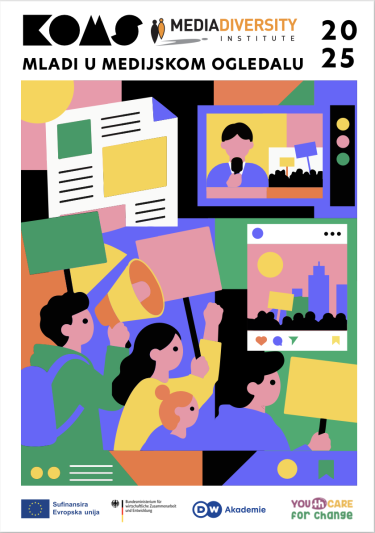
New research has revealed that increased media coverage in 2025 didn’t translate into greater opportunities for youth voices to be heard in Serbia.
After years of being most frequently associated with crime, violence, and security-related issues, topics that dominated media coverage last year included student protests, civic engagement, and activism. Young people moved from the margins of media coverage to the very centre of public attention.
Within a highly polarised media landscape, some media outlets portrayed young people as drivers of social change, while others presented them as a threat to social order, using labels such as “terrorists,” “fascists,” and “coup plotters”. In some outlets, narratives based on generalisation, stigmatisation, and the discrediting of the student movement were particularly prominent.
At the launch of the research, co-author of the study Ivan Subotić said: “Overall, media coverage of young people was more likely to be negative. Incidents involving assaults, attacks, and threats received considerably more media attention than stories with a positive framing.”
Who speaks for youth
The research, Youth in the Media Mirror, produced by Media Diversity Institute Western Balkans in collaboration with the National Youth Council of Serbia, revealed significant differences in who gets to speak about young people.
On N1 and the Nova portal, young people were the most represented sources and spoke about themselves more often than all political actors combined.
In contrast, on Pink TV, which is considered a government-oriented outlet, young people appeared in only 8 per cent of the analysed content, while the President of the Republic was represented twice as often.
On RTS, Serbia’s state-owned public radio and television broadcaster, young people were the most represented individual group of actors, but politicians and government officials collectively received more media space.
The role of the public service broadcaster
Perhaps the most striking paradox of the research concerns RTS (Radio Television of Serbia). For months, students protested in front of the broadcaster’s headquarters, demanding more objective reporting and the appointment of a new Regulatory Authority for Electronic Media (REM) Council.
However, the analysis shows that RTS covered young people less frequently than any other analysed media outlet, predominantly in a negative context. Certain student actions and protests received minimal coverage or were presented without including the voices of young people themselves. Although young people were the single most represented category of actors dominating the story, politicians and government officials collectively occupied more space in RTS coverage.
Lacking diversity
The research also found that media outlets often portrayed young people as a single, homogeneous group. In the analysed content, young people were far more frequently represented collectively than as individuals with diverse experiences, interests, and identities. In some media outlets, this approach contributed to narratives of generational solidarity, while in others it was used to stigmatise and collectively discredit young people.
Relying on social media
The second part of the research focused on the Students in blockades Instagram accounts. Faced with limited access to parts of the mainstream media, students and youth often assumed the role of media actors themselves. Through Instagram, they developed a parallel communication infrastructure used to inform the public, mobilise citizens, coordinate activities, refute accusations, and document violence they experienced. In doing so, they created their own narratives and built a media space that traditional media often failed to provide.
The Youth in the Media Mirror 2025 research analysed 1,965 mainstream media items and 1,976 Instagram posts published by student protest accounts, with the aim of examining how young people were represented in the media during one of the most significant social and political periods for youth in Serbia.
You can access the full report here (available only in Serbian).
YOU(th) CARE for Change is a project co-funded by the #eudearprogramme, supporting youth across 12 countries in tackling global challenges.
This publication has been produced with the financial support of the European Union. Its contents are the sole responsibility of the Media Diversity Institute – Western Balkans and do not necessarily reflect the views of the European Union.