Media freedom does not guarantee media diversity and inclusion, as the latest Media Diversity Index, a pilot barometer for progress in the field of media diversity, released on World Press Freedom Day, reveals.
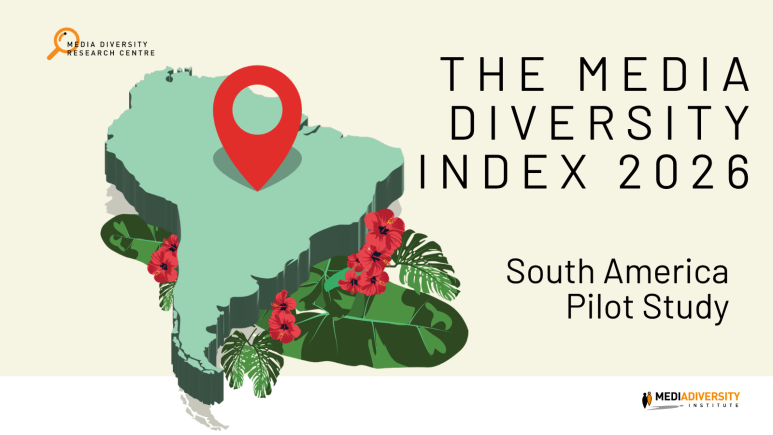
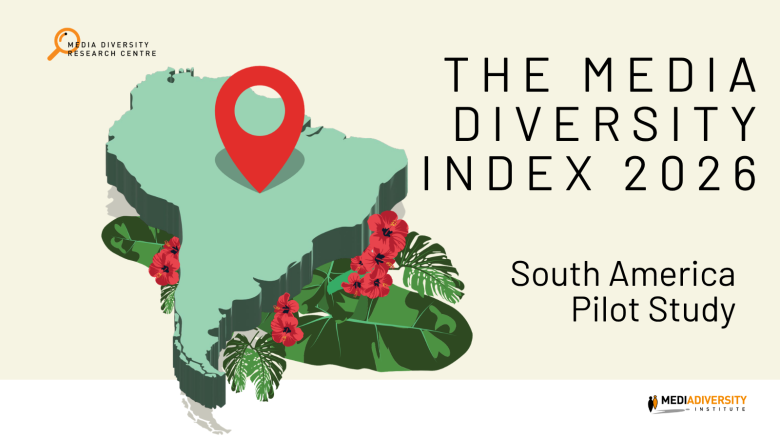
Media Diversity Index 2026 South America Pilot Study, produced by Media Diversity Institute, assesses both content and governance of the media. The newest edition includes reports on five South American countries.
It ranks Argentina last, with Uruguay and Colombia securing top places.
Systems in Argentina that previously guaranteed levels of inclusiveness in media and communications have been dismantled since the election of Javier Milei as president at the end of 2023, contributing to that country occupying last place on the index.
“Freedom creates the possibility of inclusion—it doesn’t guarantee it. Whether diverse voices are actually heard depends on deeper structural issues—ownership, inequality, and access—not just freedom alone,” said Milica Pešić, Executive Director of Media Diversity Institute.
“In countries like Uruguay and Chile, where we applied our Index, press freedom is generally strong. But our Index reveals gaps and concerns regarding diversity, with Chile falling below Uruguay, Colombia, and Peru in our scoring system. Argentinian media are far from inclusive of diverse voices,” she added.
South American rankings
Peru and Chile also feature on the South America Index, which follows earlier editions covering eleven countries in mainland Europe in 2024 and the UK in 2025.
Peru’s third-place position, against a backdrop of institutional instability in the country, is partly due to civil society activity, including provisions for self-regulation by media professionals and multiple opportunities to lodge complaints about discriminatory reporting.
In Chile (34.75), a lack of provisions or regulations on matters of discrimination, minorities or incitement to violence or hatred in media content extends to workforce composition, except for people with disabilities. Yet the diverse ethnic and cultural makeup of Chilean society means that both media content and its producers are often diverse.
Of all countries in the three pilot Indexes (17 in total), Argentina ranks last with a score of 24.00 (out of 80).
The five countries in the South America Index were selected using the same criteria as those in Europe; there are glaring discrepancies between their rankings in two other relevant indexes: the Economist Intelligence Unit (EIU) 2024 Democracy Index and Reporters sans frontières (RSF) 2025 Press Freedom Index.
Comparisons to the European Index
With scores of 46.25 for Uruguay and 42.75 for Colombia, the countries are on par with Tier 2 European nations. Tier 2 rankings, with scores between 43 and 48 out of 80, reflect a situation in which inclusivity may be aspired to in principle without being translated into policy.
Uruguay and Colombia were awarded higher scores due to institutional frameworks in both nations that have the potential to recognise and promote diversity in the media. However, both have gaps in implementation and fragmented or flawed monitoring.
The top scoring country in the European Index is the UK (65.25), followed by Belgium (62.00).
South America’s top-ranking country, Uruguay, sits below Greece (47.75) and ahead of Austria (45.25).
Colombia (42.75) and Peru (38.75) rank below Slovakia (43.00) but ahead of Cyprus (35.25), Albania (33.25) and Malta (28.75).
Chile (34.75) sits directly below Cyprus but above Albania, Malta and Argentina.
Of all countries in the Indexes (17 in total), Argentina ranks last with a score of 24.00.
Recommendations
The Index makes several recommendations including:
- Seek out openings for advocates of inclusive media to establish or develop links and contacts with existing national institutions set up to serve audiences and human rights observance.
- Strengthen and extend references to diversity across journalistic codes of conduct.
- Focus on the media needs of children, for whom the age element of diversity often intersects with other aspects such as gender, socio-economic status, disability and so on.
- Liaise with academic institutions and other civil society bodies to investigate diversity of personnel in media workplaces to fill major gaps in knowledge and puncture misplaced complacency about current performance.
- Include reflection on media diversity as a regular feature of gatherings that bring media specialists together with the aim of mainstreaming discussion about representation of those aspects of identity – such as ethnicity, socio-economic status, regional location – that are often overlooked.
Promoting change
Through a pioneering a set of indicators and a scoring system, the Media Diversity Index has the potential to inform government and civil society efforts to promote media diversity.
Combined, the three phases of the project are a step towards developing a global index that stakeholders inside and outside the media industry can use as a benchmark for evaluating the performance of media in specific countries regarding diversity and inclusion.
Access the report:
Earlier Media Diversity Indexes are also available to read online:
The Media Diversity Index 2025. What the Pilot Index Highlights about the UK.
Media Diversity Index. A Pilot Study. 2024.
You can also listen to an earlier podcast with Index lead Naomi Sakr.