By Theo Hall
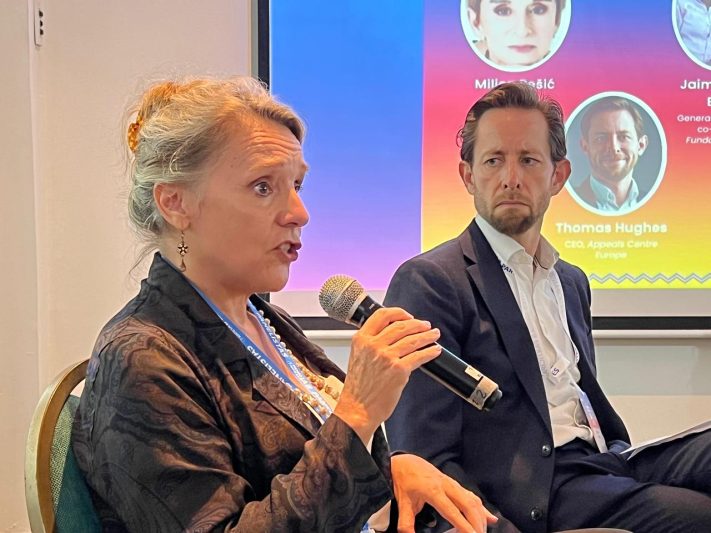
This article reflects the panel “Is AI Promoting Astroturfers and Sockpuppeteers over Diversity?”, hosted by MDI on 24 October 2025 at UNESCO Global Media and Information Literacy Week in Cartagena, Colombia. For full event details, speakers and context, visit our event page.
On the morning of October 24th, the Kalamary Room began to fill around eleven o’clock. There was a growing sense of anticipation surrounding a topic that is no longer merely speculative. Artificial intelligence has integrated itself as a structural component of professional communication and a challenge for democratic systems. As the attendees settled in, a conversation that sought to clarify the urgent questions shaping this new technological and cultural era began.
Milica Pešić, Executive Director of the Media Diversity Institute, opened the session by introducing three key concepts she considers essential for understanding how AI is reshaping today’s media environment. She began with diversity, a familiar idea, but the next two terms were, as she acknowledged, “completely bewildering at first glance” for many people in the room.
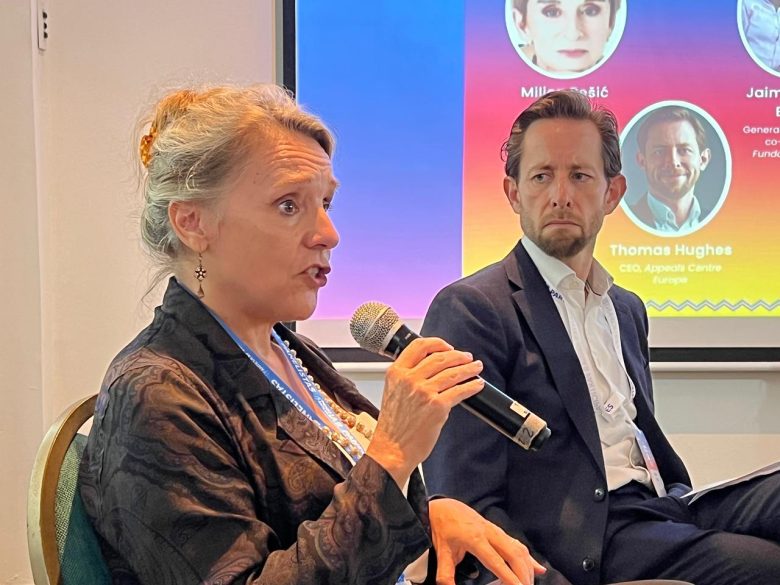
She explained the concept of sockpuppeteering, the creation of fake online identities that pretend to be real individuals, now made even more convincing by AI systems. Then she broke down astroturfing, which occurs when powerful actors create the illusion of a spontaneous public movement even though it has been carefully orchestrated behind the scenes. She also noted that AI technologies make both practices easier to manufacture and much harder to detect.
After outlining these concepts, she emphasised that the impact of artificial intelligence should not be understood only as a technical shift; the deeper challenge is protecting the integrity of journalism in a world where automated systems produce information at a pace no human newsroom can match. She warned against an ‘unquestioning surrender to machines,’ even as the surrounding environment becomes more automated and opaque.
Vehicle of propaganda
Jaime Abello Banfi, Director General of Fundación Gabo, echoed this idea, focusing on the quality of democracy. He noted that the region is experiencing a moment in which the spread of misinformation requires very little technical engineering to cause harm. The arrival of generative AI models amplifies the rate at which disruptive content can spread and interfere with elections or social crises. For him, the central question is whether institutions, citizens, and the media can adapt to the pace of this transformation and avoid falling behind to less transparent actors.
Abello Banfi linked these risks to a larger structural issue. He explained that artificial intelligence is not built to protect diversity or public interest. It is created to maintain control over people’s attention, which often benefits those who already hold power. “The people who own and design these systems decide what they want to promote and determine what the public will receive.” Abello also stated that this generates the illusion that AI can fix everything, when in reality it often repeats the same biases and mistakes that have been made before. This is why he described AI as “the most powerful vehicle of propaganda ever invented, capable of spreading messages at a scale far beyond any newsroom”.
For him, this demands a clear and firm response from journalism. Reporters must defend their role: checking facts, asking questions, and resisting pressure from powerful groups. Double-checking information is no longer optional; it’s the basis of public trust. If the media abandons this responsibility, audiences will depend entirely on systems that do not explain how they work and that offer simplified answers based on averages rather than understanding. He insists that journalists must help people think, not just scroll, so their “minds and spirits are not hacked by constant streams of automated content”.
Despite this outlook, Abello Banfi pointed toward a hopeful path. He believes that local reporting is one form of journalism that will continue to thrive. It depends on human presence, on knowing the community, and on understanding the nuances that exist within our daily lives. These are things AI cannot replace. Local reporters can offer context and clarity where people live, work, and vote. This closeness, he suggested, may be the strongest defense against the confusion and speed of the digital world.
Shaping behaviour and perception
Sandra Acero, Programme Manager at CIVIX Colombia, shifted the discussion to the realities of daily practice. She spoke of the pressure journalists and organisations face to incorporate new tools without clear ethical criteria to guide them. She explained that the accelerated adoption of generative AI systems creates vulnerabilities in both producing and validating information. She stressed that the value of human judgment cannot be diluted by indiscriminate automation. “Urgency cannot replace responsibility.”
Divina Frau-Meigs, a professor from Sorbonne Nouvelle University and UNESCO Chair Savoir Devenir, broadened the conversation by including media ecology. She pointed out that digital environments driven by artificial intelligence no longer function as mere channels. They shape behaviour and perception. She highlighted that algorithmic architecture can produce bubbles and echo chambers that distort public discourse if not effectively regulated. Frau-Meigs also emphasised the opportunities to strengthen digital literacy and to build mechanisms that help audiences understand how the information they consume circulates. She insisted that AI language models must be treated as what they are: machines with failures and corporate intentions built into them. “They don’t think, they generate averages.”
Thomas Hughes, Executive Director of Appeals Centre Europe, brought the discussion to a deeper truth that ran beneath the entire session. Technology will always move faster than any rulebook. The real task is deciding what we want to protect as that acceleration unfolds. The concern is no longer just how artificial intelligence works, but what kind of public life it will sustain. If the region does not define the values it wants to preserve and the responsibilities it expects from those who design these tools, others will decide for it. At that point, the debate will cease to be technical and become fully political. It becomes a question of what kind of society we want to remain in as the line between human judgment and automated processes grows increasingly blurred. And that future will not shape itself. It will not happen if governments remain passive. It will not happen if citizens assume the responsibility belongs only to institutions or experts. The region will need public pressure, political will, and a shared sense of responsibility to turn these concerns into real action. Otherwise, the gap will continue to widen until the region realises, too late, that the rules were written elsewhere.
Watch the full recording of the panel discussion: https://fb.watch/D13khltsss/
The views and opinions expressed in this article are solely those of the author and do not reflect the official policy or position of the Media Diversity Institute. Any question or comment should be addressed to [email protected] of the Media Diversity Institute (MDI).