By Christiana Warne
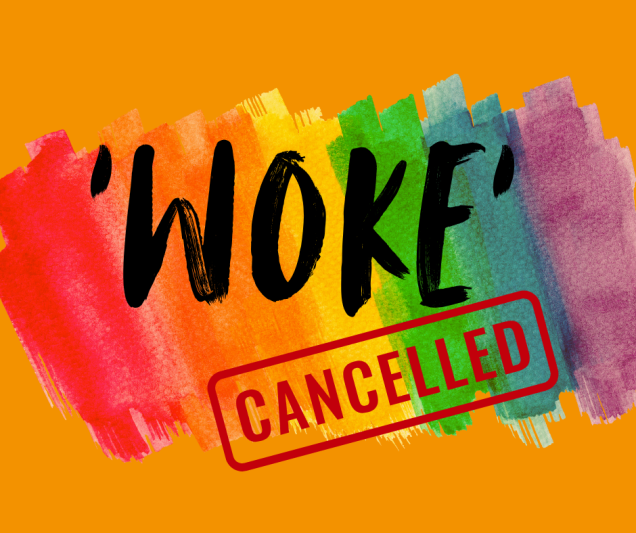
‘Woke’: What is it?
What started as a tool for justice and peace, stemming from the Black Lives Matter Movement, has now become a term wielded as a political weapon by the Right. Woke used to mean being aware of important issues of racial and social justice. Since then, the word has been tainted and its meaning has been warped, with a negative stigma now surrounding it. Woke reached its peak several years ago, with a 2022 YouGov report stating that more people were aware of the term, with 57 per cent knowing it, than in 2021 (41 per cent).
What do people think about ‘woke’ today? As a university student, I wanted to find out how, or if, my generation relates to the concept.
An illustration student studying at the University of Westminster told me, “the word is mostly mocked by the right wing (and used) for people who are “overly sensitive” by everything”. They go on to say that they believe ‘woke’ “is a good thing, as it is good to be aware (of) social impacts even if (they don’t) necessarily impact us (directly).”
A creative viewpoint
For someone born into Generation Z, the term is widely used on social media and seems to have been kept alive by a hyperbolic sense of influence. Concepts are often taken out of proportion. The creative student emphasised this by saying that “there is more bad (on social media) as some situations are blown over.”
The illustration student seemed to understand both the positive and negative attributes of the word, stressing that the negativity it radiates is amplified by social media.
I applied her answer to the idea of cultural appropriation, as described in an article by News Discourses. It explained that when the concept mimics a culture, it takes away its value.
For example, using the AAVE dialect or a ‘blaccent’ (a black accent) has become popular and individuals who should not be using it are, as they believe it sounds cool; a vain reason that is insensitive to people of colour and their history.
A negative action like this is usually ‘cancelled’, a term deviating from ‘woke’, entailing the withdrawal of one’s support for public figures. A report published by Kings College London said that the percentage of people who have heard of the term ‘cancelled’ had risen from 39 per cent in 2020 to 60 per cent in 2022.
An article by Impakter comments on how ‘wokeness’ is performative when applied to social media, e.g. the use of hashtags which minimise the weight and sensitivity of an issue by shortening it and making it a one-dimensional label for people to utilise for personal gain and sympathy. This emphasises woke’s toxic relationship with social media.
“Omg that’s woke. You’re so woke. That’s a very woke take.”
These are some of the phrases I’ve heard on social media and among my generation’s conversations. There’s a sense of ambiguity here, with no clear indicator as to whether woke is used as a compliment or insult. The Kings College report found that 36 per cent of individuals consider ‘woke’ to be an insult if they are called that, an increase from 2020 when only 24 per cent held this belief.
However, as a creative student myself and also a current intern at Media Diversity Institute, I wanted to see how students outside my field relate to woke, so I approached STEM students studying at City St George’s, University London.
A STEM viewpoint
I asked a student studying Mathematics and they said they have no personal definition of woke, “it doesn’t mean anything to me”. They viewed it as “an adjective meaning progressive”.
Their interpretation of woke is more rational and logical, emphasised by another student studying Computer Science saying “woke is the simple past tense verb for the word “wake””.
The creative student was aware of social media’s impact regarding ‘wokism’, but the STEM students are not as aware of ‘wokism’ in the media.
The Computer Science student, when asked about the media’s influence, said “generally, it’s a positive word however, based on how it’s been thrown around on the news, I can only assume it is mentioned in a negative context”.
It is interesting to see that the creative student acknowledges the positives and negatives to ‘woke’ whereas the STEM students are indifferent but, generally assumes ‘woke’s’ negativity. Both are aware of the term, but STEM students know the term literally, compared to the creatives who understand its political and ethical meaning.
Does woke have a future?
I believe based on the answers I received, ‘wokism’ is still alive.
This is a view also expressed in an article by ITV, which discusses how woke is not necessarily dead, but instead it has shifted on the political spectrum, with the right now being in a ‘wokist position’, criticising the left. A recent example was Elon Musk speaking via a video link at a UK rally organised by Tommy Robinson, where he spoke against the ‘woke mind virus’.
The takeaway
After talking to students for this article, I have to agree with the view that ‘woke’ is not dead.
Elements of ‘woke’, like cancel culture or cultural appropriation as discussed, are still present in today’s media even though the term ‘woke’ is not explicitly used. However, because of woke’s shift in the media, I do not think it holds as much power as it did previously, and its power will continue to fizzle out.
Creative students value ‘wokism’ more than STEM students. While this answer may have been expected, I realised something; the creative and STEM students care about ‘wokism’ in different ways that cannot be measured against each other, and would be unfair to do so.
The views and opinions expressed in this article are solely those of the author and do not reflect the official policy or position of the Media Diversity Institute. Any question or comment should be addressed to [email protected] of the Media Diversity Institute (MDI).